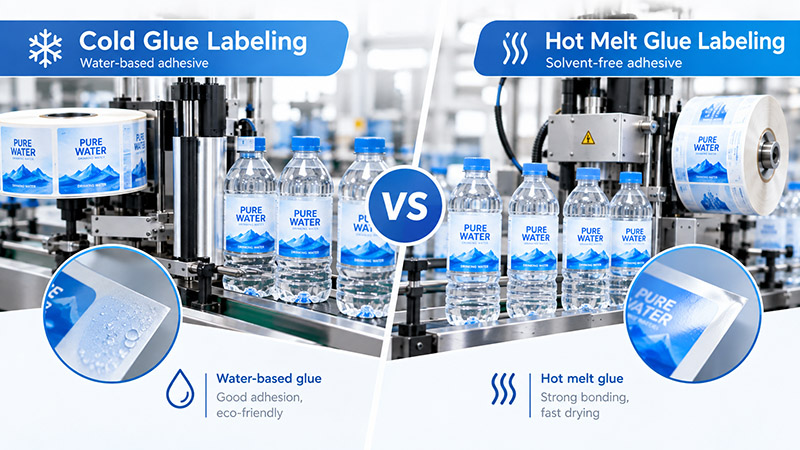
Cold glue and hot melt glue are often presented as two speeds of the same method. That framing hides the real difference. Cold glue exists to apply paper. Hot melt glue exists to apply film. Everything else follows from the material you need on the bottle.
Cold Glue vs Hot Melt Labeling: Two Adhesives, Two Materials
Cold glue labeling picks up a paper label, coats its back with a resin based adhesive at the turret, and transfers it to the bottle through a vacuum belt and a set of brushes. The adhesive stays cold throughout, hence the name.
Hot melt glue labeling melts solid adhesive in a heated tank and applies it to a film label, usually OPP or BOPP, immediately before the label meets the bottle. The film is what makes it water resistant, not the glue alone.
| Item | Cold glue | Hot melt glue |
|---|---|---|
| Label material | Paper | OPP, BOPP, paper, multi layer film |
| Adhesive | Resin based, applied cold | Solid, melted in a heated tank |
| Machine | JND-M | JND-200R / JND-400R |
| Rated speed | 60-500 BPM | 150-350 BPM |
| Bottle diameter | 40-110 mm | 50-95 mm |
| Label size | 10-120 mm by 120-200 mm | 10-150 mm high |
| Bottle material | Glass, PET, metal | Plastic, glass, metal |
| Air consumption | 500 litres per minute | 0.8 MPa supply |
| Power supply | AC 380 V or 220 V, 50/60 Hz | 380 V, 50-60 Hz |
Where Cold Glue Wins
Paper still costs less than film. On a high volume glass line running one product all year, that gap compounds into the largest single saving available on the labeling station, and it is the main reason breweries and wineries stay on cold glue.
Cold glue also handles the glass recycling loop better. A caustic wash strips a paper label and its resin adhesive cleanly, so returnable bottles come back ready to relabel. Film labels need more work to remove and leave adhesive residue behind.
The third advantage is appearance on glass. Paper takes embossing, metallic foil and matte finishes that read as premium on a spirit or wine bottle. Film tends to look glossy and modern, which is right for water and wrong for a single malt.
Where Hot Melt Wins
Film does not absorb water. A paper label in a cooler of melting ice will cockle, lift at the edges and eventually float off. A film label with hot melt adhesive holds, which is why every bottle destined for a cold chain uses one.
Hot melt is also more tolerant of imperfect surfaces. It bonds to plastic, glass and metal with the same setup, and the OPP film resists scuffing in transit in a way paper does not. For bottles that travel long distances on pallets, that matters more than the unit label cost.
There is a speed argument too, but it is narrower than most suppliers suggest.
Moisture, Condensation and the Cold Chain
Condensation is the single most common cause of label failure, and it is the first thing to check when a label lifts at the edges. It happens when a cold bottle meets warm humid air, which is normal in summer in most markets and constant in a chilled distribution chain.
Paper fails here in a predictable way. Fibres swell, the sheet cockles, and adhesive at the edges releases first. By the time the bottle reaches the shelf the label has a lifted corner and looks shop worn.
If the product is stored below ambient, served over ice, or shipped through a tropical climate without climate control, the material decision is already made. Start with film and hot melt, and treat cold glue as unavailable.
Speeds Overlap, So Decide on Material
A fact that surprises most buyers: the cold glue machine in our range is rated 60 to 500 bottles per minute, the hot melt machine 150 to 350. The cold glue route is not the slow one, so speed is not the deciding factor.
Both cover round container diameters from roughly 40 mm to 110 mm, both take standard air and power supplies, and both change format with mechanical adjustments rather than a rebuild.
That leaves material and environment as the only two questions in cold glue vs hot melt labeling. Does the label have to be paper, and does the bottle ever get wet? A yes to the first points to cold glue labeling equipment, a yes to the second points to hot melt glue labeling equipment. Model lists sit under cold glue labeling machines and hot melt glue labeling machines.
If neither material is fixed and the bottle is round, the cheaper comparison to run is the one between pre-glued labels and film, covered in self-adhesive against hot melt glue labeling.
Frequently Asked Questions
Is cold glue cheaper than hot melt glue?
The label is, because paper costs less than film. Adhesive cost is close. The saving shows up on high volume lines running one product, where a small unit difference compounds across millions of bottles.
Can cold glue be used on PET bottles?
Yes. Our cold glue machine covers bottles from 40 mm to 110 mm diameter in glass, PET and metal. The limitation is the label material and the moisture it will face, not the bottle material.
Do hot melt labels survive condensation?
Yes, and that is their main advantage. Both the film and the adhesive are water resistant, so a bottle taken from an ice bath keeps a flat, intact label.
Which of the two is faster?
Cold glue, at the top of the range. Our cold glue machine is rated up to 500 bottles per minute against 150 to 350 for the hot melt model. Speed should not be the reason you pick between them.