What Makes a Juice Line Different
A juice filling line looks similar to a water line, but juice brings its own problems. It is acidic, so the machine needs stainless steel parts that survive acid contact. It spoils, so the process has to keep bacteria out. And it is heat sensitive, so how you fill it decides the balance between shelf life and flavor. These three facts shape every stage of a juice bottling line.
Stage 1: Fruit Processing and Pasteurization
The line starts with the fruit itself. Fruit is extracted, filtered and blended into a base juice. A pasteurizer then heats the juice to kill microorganisms. The exact temperature and time depend on the recipe, but the goal is the same: a stable product that will not spoil on the shelf.
Stage 2: Deaeration and Blending
Before filling, dissolved oxygen is removed from the juice in a deaerator. Oxygen speeds up spoilage and darkens color, so removing it protects both shelf life and appearance. The juice may also be blended with water, sugar or additives at this stage to hit the recipe.
Stage 3: Hot Fill vs Aseptic (the Key Choice)
This is the decision that shapes the whole line. There are two ways to fill juice, and they give different results:
- Hot fill. The juice is filled at 85 to 92 degrees Celsius. The heat sterilizes the bottle and the cap as they are filled, so the product needs no preservatives and can sit on the shelf for months. The trade-off is that heat can soften some flavors.
- Aseptic filling. The juice is cooled and filled in a sterile environment. Flavors stay fresh and energy cost is lower, but the line needs more complex sterilizing equipment.
Most juice producers pick hot fill for orange juice, mango nectar and other shelf-stable products, and aseptic for premium juices where fresh taste is the selling point.
Stage 4: Bottle Making
PET bottles are made in-house with a blow molding machine, or glass bottles are supplied ready. Hot fill needs bottles that can handle the heat, so the bottle design and material choice matter more than in a cold line.
Stage 5: Filling
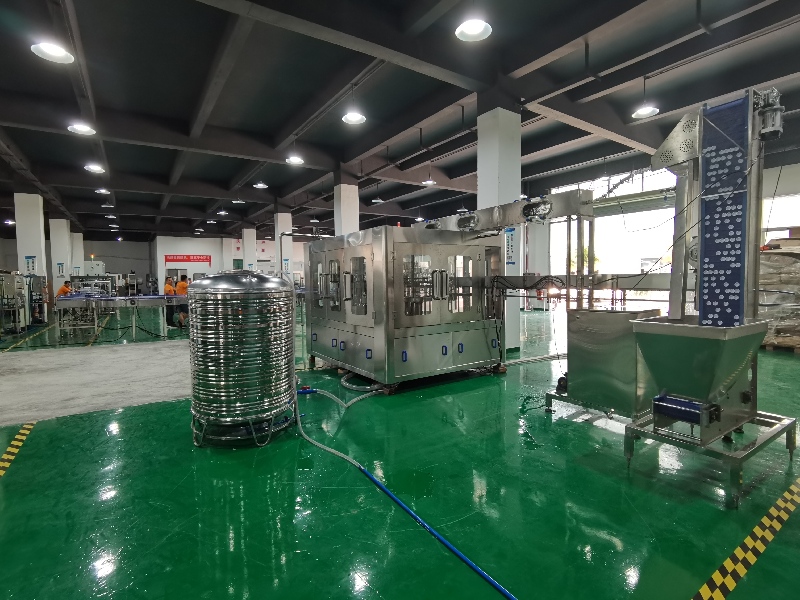
The filling machine is a 3-in-1 monoblock that rinses, fills and caps in one frame. Juice lines use flow meter or positive displacement filling for accurate volume. For pulpy juice, the valves are enlarged so pulp and fiber pass through without clogging, and an optional pulp dosing system keeps the fiber content consistent in every bottle.
Stage 6: Capping
Caps are applied right after filling, while the product is still hot in a hot fill line. The heat creates a vacuum seal as the bottle cools, which helps keep the product fresh. Cap detectors reject any bottle with a missing or skewed cap.
Stage 7: Warming, Labeling and Packing
Cold-filled juice may pass through a bottle warming machine to stop condensation on the label. Then the bottles are labeled, packed into retail packs by a shrink wrapper or case packer, and palletized for shipping.
Hot Fill or Aseptic: How to Choose
The choice comes down to three things: shelf life, taste and cost. Hot fill gives long shelf life with simpler equipment and no preservatives. Aseptic keeps delicate flavors and saves energy but costs more to set up. Tell your supplier your product, target market and shelf life, and they can size the line around the right method.
Frequently Asked Questions
Can one juice line handle pulp juice and clear juice?
Yes. Anti-clog valves handle pulp juice, and a quick changeover switches to clear juice in a few minutes. Optional pulp dosing keeps fiber content consistent.
What is the difference between hot fill and aseptic filling?
Hot fill uses juice at 85-92 degrees Celsius to sterilize the package, giving long shelf life without preservatives. Aseptic filling keeps flavors fresh at lower energy cost but needs more sterilizing equipment.
What bottle types does the line support?
PET and glass bottles from 200ml to 2L, round or square, with screw caps. Change parts switch formats quickly.
Do you supply the complete juice line?
Yes. JNDTECH supplies pasteurizer, filling monoblock, warming tunnel, labeling and packing as one turnkey juice bottling line, with installation and training included.
Plan Your Juice Filling Line
JNDTECH designs and builds juice filling lines from 2,000 to 24,000 BPH, with layout design, bottle and mold development, installation and training all included. Contact JNDTECH for a free layout drawing and quotation.