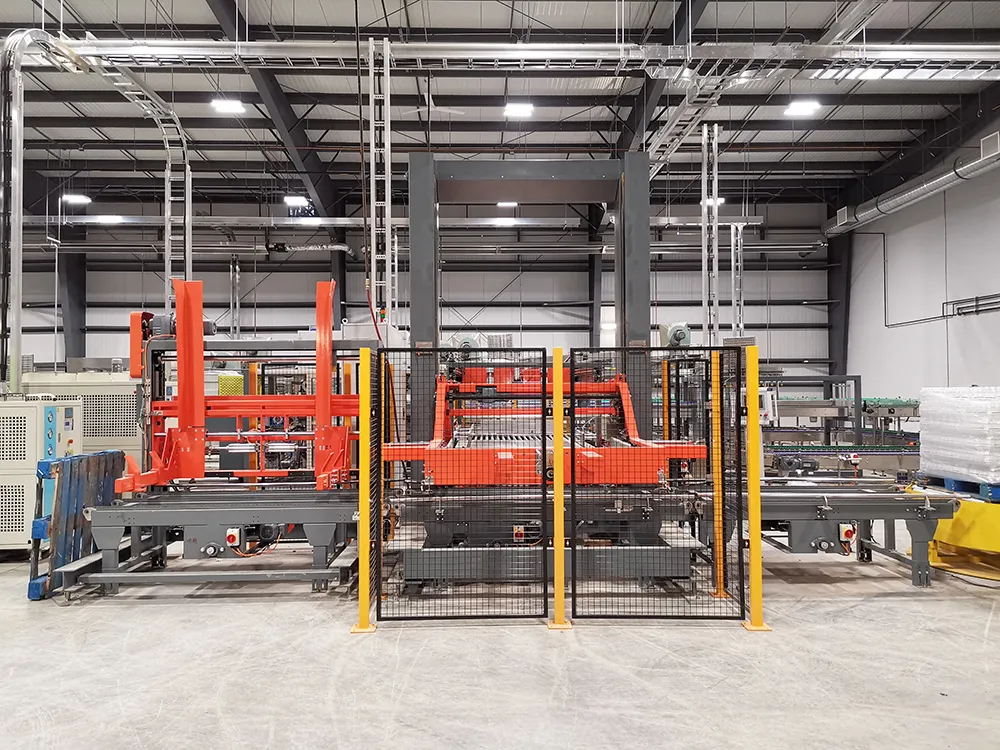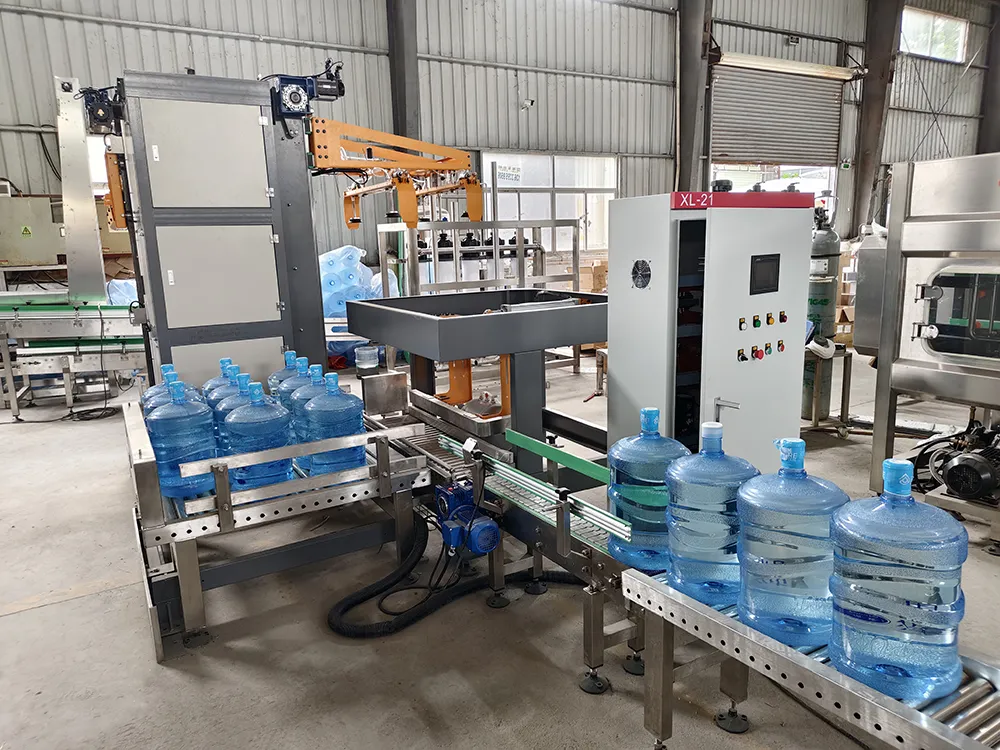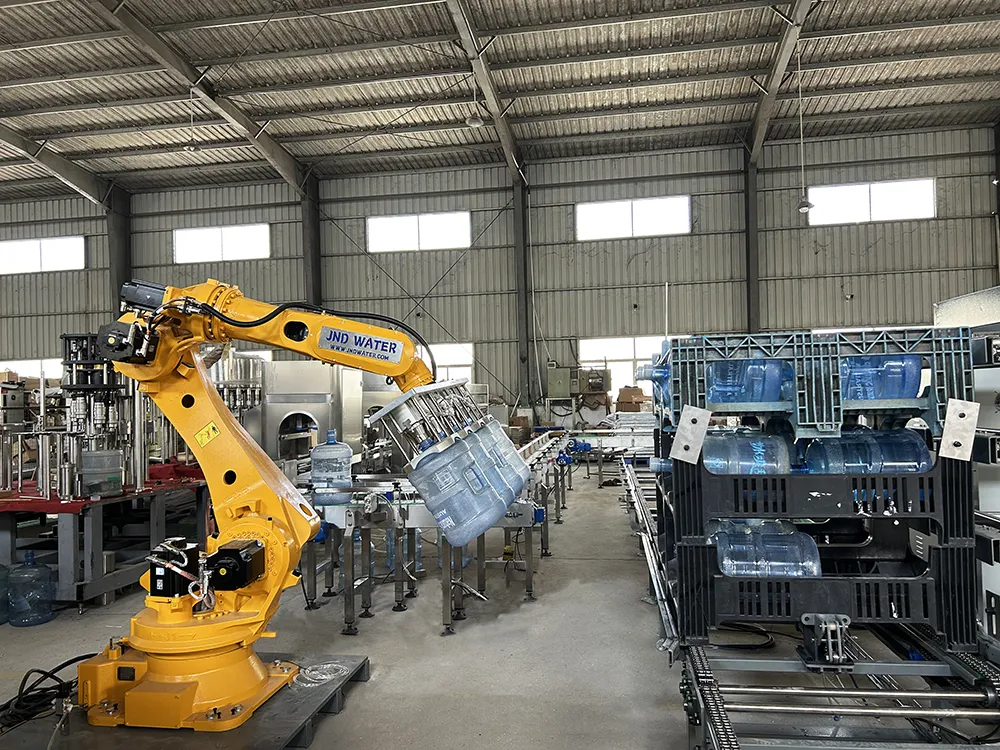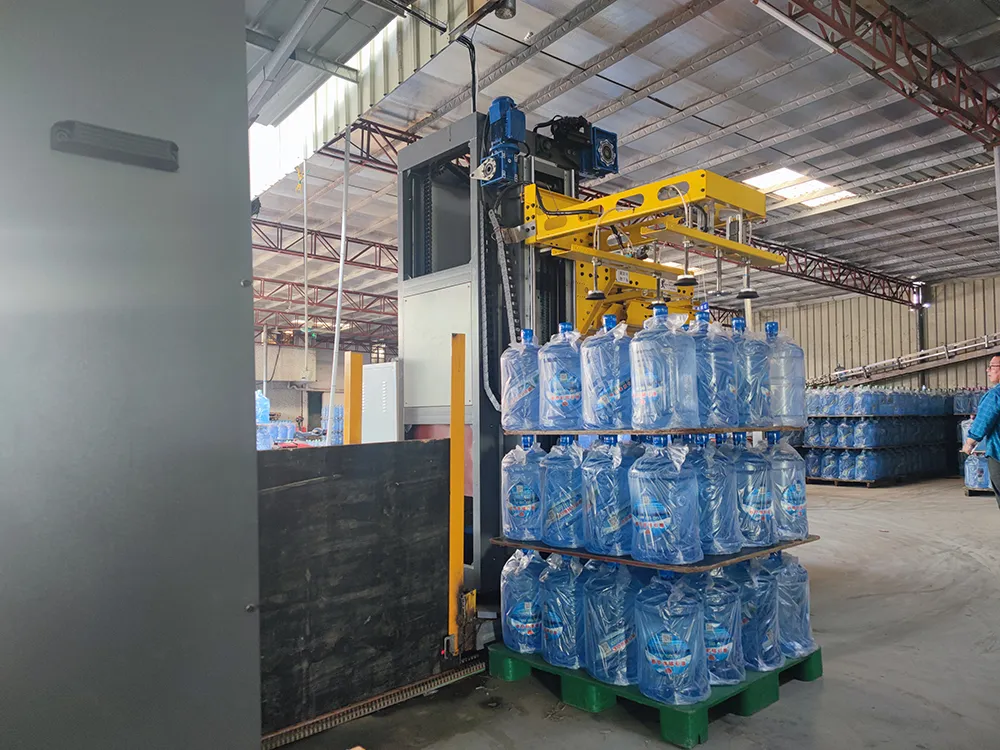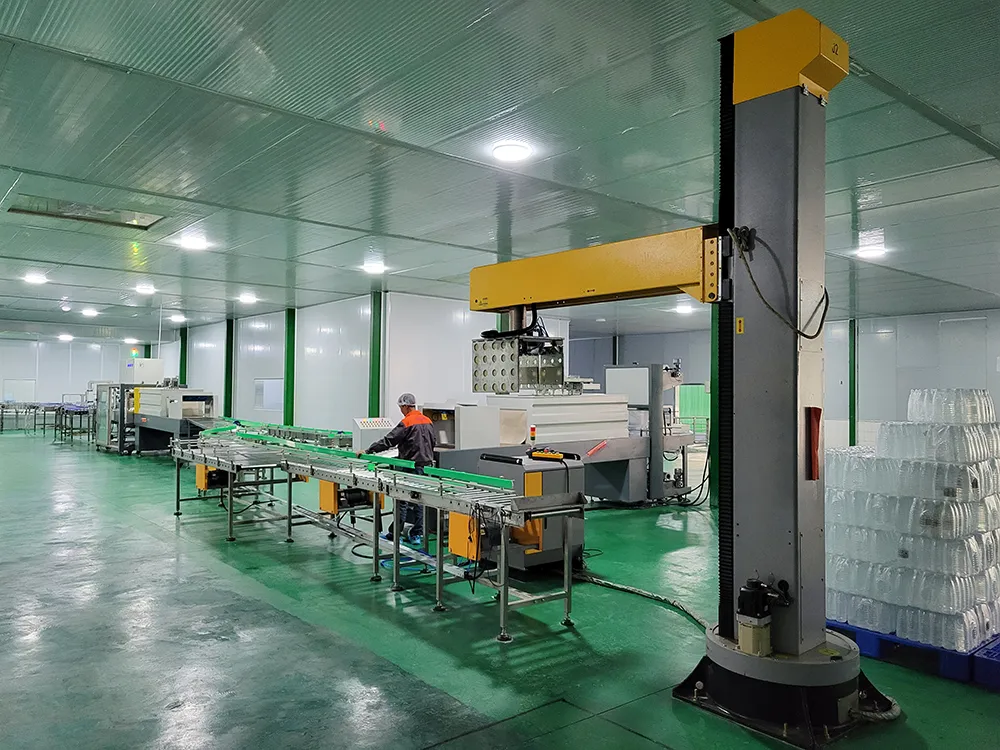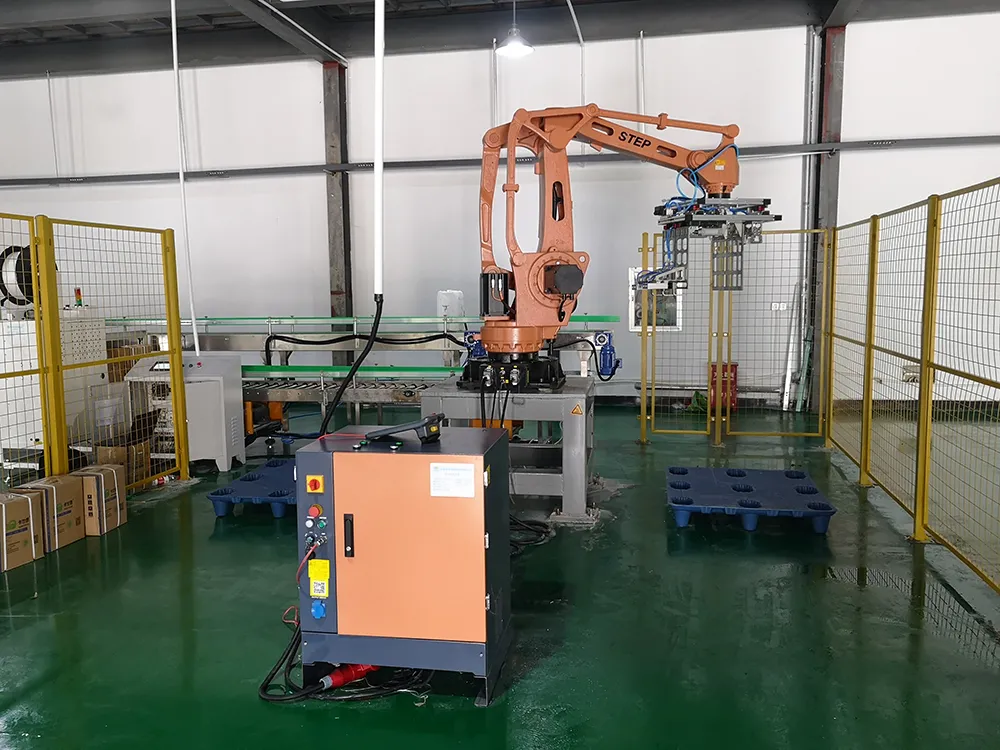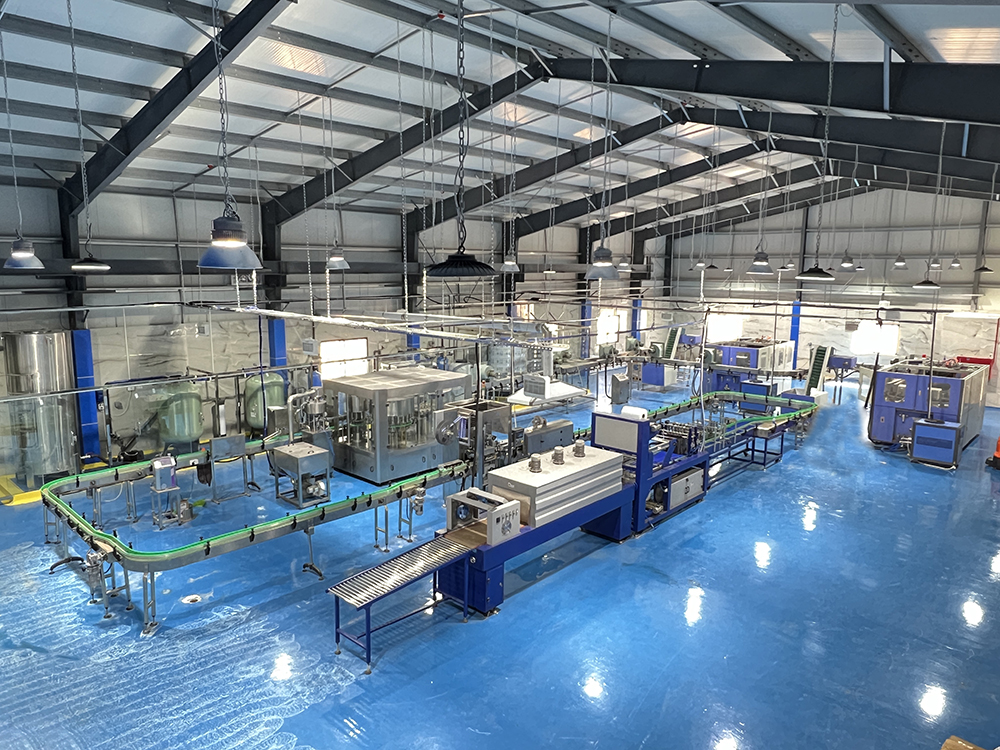
On the production line of a beverage factory, the palletizing machine impacts the overall efficiency of the entire plant. After products pass through the high-speed filling line and undergo precise labeling and efficient packaging, how to stably, neatly, and efficiently stack these finished products into pallets directly affects warehouse logistics efficiency and the company’s labor costs.
As a beverage plant equipment supplier serving over 125 countries worldwide with more than 9,000 installations, JNDWATER presents this customized palletizing robot selection guide tailored specifically for beverage factories.
Why is the palletizer machine process in beverage factories worthy of special attention?
- The Terminator of Efficiency Bottlenecks: Manual palletizing is limited in speed (approximately 300-500 cases/hour/person), prone to fatigue, and unstable in efficiency, often becoming a constraint for the entire filling line. Automated palletizing machines can achieve 800-2000 cases/hour, fully eliminating the bottleneck at the production line’s end.
- Key points for cost optimization: The annual labor cost for a single palletizing worker can reach tens of thousands of yuan, coupled with challenges such as recruitment difficulties and high turnover. The investment in a palletizing robot can typically be recouped within 1.5 to 2.5 years.
- The Final Line of Quality Assurance: Manual palletizing often leads to misaligned stacking and cargo damage, compromising transportation safety and brand image. Machine palletizing ensures neat stacking and uniform pressure distribution, significantly reducing transportation damage rates.
- Capacity Assurance During Peak Seasons: The beverage industry exhibits significant seasonality, where manual palletizing struggles to handle production surges during peak periods. Palletizing machines, capable of 24/7 stable operation, ensure timely order delivery during these high-demand seasons.
As JNDWATER summarized while serving over 450 food and beverage factories worldwide: “The efficiency at the front end of the production line determines the upper limit of production capacity, while the efficiency of the back-end palletizing process dictates the actual output.”
2、 Types of palletizing robots in beverage factories
| type | working principle | Core strengths | limitation | Applicable scenarios |
| Joint robot palletizer | Imitating human arms, 4-6 axis linkage, flexible movements | High flexibility, adaptable to various product specifications; Large scope of work | High investment and relatively complex programming | A comprehensive beverage factory with variable product specifications and frequent production changes |
| Cartesian coordinate robot palletizer | Moving in a straight line along the X/Y/Z axes, with a structure similar to a gantry | Fast speed, high precision, simple structure, easy maintenance | Restricted movement trajectory and low flexibility | Large scale water plants with single or few specification products and pursuit of extreme rhythm |
| High/low position palletizer | Specialized mechanical structure, stacked layer by layer | Specially designed for dedicated aircraft, with extremely fast speed and compact structure | Poor flexibility, usually only able to handle a single specification | High speed pure water filling line, large-scale production of single products |
| Collaborative robot palletizer | With force sensing, it can safely collaborate with people in the same space | Flexible deployment, secure without the need for fences, simple programming | Low load (usually<20kg), slow speed | Small and medium-sized renovation projects with limited space |
3、 Six core considerations for palletizing selection in beverage factories
- Product packaging form: Starting from “what code”
The packaging form of beverage factories is much more complex than that of water plants, which directly determines the selection direction of palletizers:
| Packaging form | Common beverage types | capture method | Recommended palletizing models |
| carton | Juice, tea drinks, functional drinks, gift boxes | Vacuum suction cup (grabbing box surface) or gripper (grabbing side surface) | Joint robot (with optimal flexibility) |
| Heat shrink film package | Pure water, carbonated beverages, beer multi pack packaging | Vacuum suction cup (grabbing the flat surface at the bottom of the film package) | High position palletizer (fastest speed) or articulated robot |
| Plastic film wrapping | A whole tray of beverages | Fork plate (taken from the bottom fork) | Specialized wrapping and palletizing machine |
| Full layer can | Beer, carbonated beverages | Magnetic suction cup or specialized layer clamp | High level palletizing machine or specialized layer coding machine |
| Turnover box/plastic box | Glass bottle beverages, recycled packaging | Claw (grabbing the edge of the box) | Articulated robot |
If your product packaging form is single (such as only producing film wrapped purified water), a high-level palletizer is the most efficient choice; If the product line is rich and the packaging is diverse, the flexibility value of articulated robots will be fully reflected.
- Production cycle: determines speed requirements
End of line speed: How many boxes does your packaging machine produce per minute? This is the basic basis for choosing the speed of the palletizer.
- Stacking layer complexity: Simple staggered stacking is fast, while complex display surface stacking requires more time.
Peak production capacity: The beverage industry has a clear peak season, and it is recommended to select products based on 120% of the peak production capacity and reserve buffer space.
JNDWATER empirical formula: palletizing machine cycle time ≥ packaging machine cycle time × 1.2
4、 Summary: Find Your Best Match
Choose a palletizing robot suitable for beverage factories, there is no “best” product, only the “most suitable” solution. The key is:
- Recognize your product: Is the packaging form single or diverse? Frequent or stable production changes?
- Calculate real demand: What is the peak production capacity? Are there any plans to expand production in the next three years?
- Evaluate spatial conditions: What is the net height of the factory building? Is there sufficient ground space?
- Calculate the economic account: What is the investment budget? How many years do you expect to recoup your investment?
- Consider future expansion: Will new product specifications be added? Do you need an intelligent upgrade?
As JNDWATER, which has been deeply involved in the field of beverage equipment for more than ten years, we have served over 450 food and beverage factories in 125 countries worldwide and accumulated rich experience in palletizing applications. Whether you are the first automated production line of a startup beverage brand or the intelligent upgrade of an international beverage giant, we can provide you with matching solutions.
If you are planning an automated palletizing upgrade for your beverage factory, please feel free to contact Jndwater