Thinking about how to start a bottled water company? You are not alone. Clean drinking water is a non-cyclical, daily-demand product, and a properly planned plant can generate steady cash flow for decades. But most first-time founders get stuck on the same questions: which water type, how much capacity, what machines, and how much money?
This guide walks you through the entire launch roadmap — from picking your product to choosing equipment and estimating ROI. It is written for practical people who want a working plant, not a textbook. (If you also plan juice, soda or other drinks, the same line logic applies — see our beverage production line guide.)
1. Is a bottled water business worth it?
2. Choose your water type
3. Licensing & regulations
4. Plan your production capacity
5. Core equipment you'll need
6. The bottling line workflow
7. Estimate investment & ROI
8. How to choose a supplier
9. Launch & scale
FAQ · Conclusion
1. Is Starting a Bottled Water Company Worth It?
Bottled water is one of the few consumer goods with universal, repeat demand. Unlike fashion or electronics, people buy it every day regardless of the economy. For an entrepreneur, that means:
- Predictable demand — households, offices, schools and retailers all need it.
- Scalable model — start with one line, add SKUs (5 gallon, 1L, flavored) as cash flow grows.
- Local advantage — water is heavy and cheap to produce but costly to ship, so a local plant usually beats imports on price.
2. Choose Your Bottled Water Type
Your water type decides your source, treatment and machinery. Pick based on local regulation, source availability and target price point.
| Type | Source | Treatment | Typical package | Barrier to entry |
|---|---|---|---|---|
| Purified water | Municipal / well | Reverse osmosis (RO) | 0.33–1.5L PET, 5 gallon | Low |
| Mineral water | Certified spring / mineral source | Minimal (protect minerals) | 0.5–1.5L PET | High (source license) |
| Drinking water | Municipal | RO + remineralization | 0.33–1.5L PET | Low–Medium |
| 5 gallon / 20L | Municipal / well | RO + ozonation | Refillable jug | Low |
For most first-time founders, purified (RO) water or 5 gallon is the fastest, lowest-risk start. Natural mineral water commands a premium but requires a certified source and stricter approvals.
3. Licensing & Regulations (General Checklist)
Requirements vary by country, so confirm with your local authority — this is not legal advice. Common items include:
- Business registration and tax certificate
- Food production / bottling license (often HACCP or equivalent)
- Water source approval and regular quality testing
- Factory hygiene, wastewater and environmental compliance
- Product labeling that meets local food-label rules
4. Plan Your Production Capacity
Capacity is measured in BPH (bottles per hour). Size it to your market, not your ambition — a line running at 30% load wastes money, while one at 110% loses sales.
| Scale | Capacity | Best for | Automation |
|---|---|---|---|
| Micro / pilot | 1,000–2,000 BPH | Villages, offices, testing the market | Semi-auto |
| Small | 3,000–6,000 BPH | Local brand, regional distribution | Automatic |
| Medium | 8,000–12,000 BPH | City-wide / multi-SKU | Automatic rotary |
| Large | 18,000–36,000+ BPH | National / export | High-speed combi |
Unsure which? A 5 gallon line is often the smart first step: simpler, cheaper, and it builds recurring delivery customers before you expand to retail PET.
5. Core Equipment You'll Need
A complete bottled water filling line usually contains five stations. You can buy them as one integrated turnkey line (recommended) or piece by piece.
5.1 Water Treatment System
The heart of quality. A typical purified-water train: sand filter → carbon filter → softener → precision filter → RO membrane → UV/ozone sterilization → pure water tank. For mineral water you protect natural content instead of stripping it.
5.2 Blow Molding Machine
Makes empty PET bottles from preforms. Choose semi-auto for low volume or fully automatic rotary for high speed. Output must match your filler.
5.3 Water Filling Machine
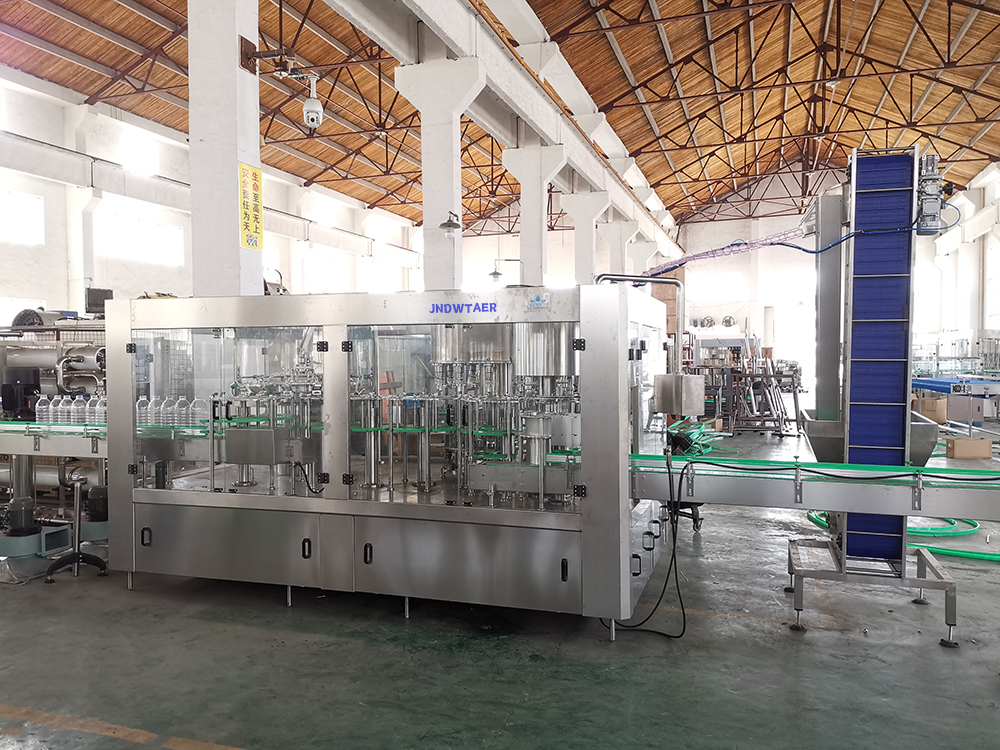
The 3-in-1 rinsing-filling-capping monoblock is the standard: bottles are rinsed, filled by gravity/weight, then capped — all in one sanitary block. This is the machine most people mean by "water bottling machine."
5.4 Labeling Machine
Self-adhesive, OPP hot-melt or shrink-sleeve labeling, chosen by bottle shape and budget. Shrink sleeve looks premium and suits odd shapes.
5.5 Packing Machine
Shrink-wrap or carton packer plus optional palletizer for efficient palletizing and transport.
6. The Bottled Water Production Line Workflow
- Source water → treated through the RO / mineral train to spec.
- Blow → preforms become bottles (or use purchased empty bottles).
- Rinse → Fill → Cap in the monoblock (the core bottling step).
- Label → apply brand label/shrink sleeve.
- Inspect → empty/full bottle check, cap torque, fill level.
- Pack → bundle into film or cartons.
- Palletize & warehouse → ready for distribution.
7. Estimate Your Investment & ROI
Costs vary widely by capacity, automation and local conditions. Indicative ranges (machinery only):
| Setup | Machinery estimate (USD) | Notes |
|---|---|---|
| Semi-auto micro line | $15,000 – $40,000 | 1,000–2,000 BPH, lower labor efficiency |
| Small auto line | $60,000 – $120,000 | 3,000–6,000 BPH |
| Medium auto line | $120,000 – $250,000+ | 8,000–12,000 BPH, rotary |
Add land/building, utilities, permits, trucks and working capital on top. ROI depends on local bottle price and volume; many operators reach payback in 12–36 months at healthy utilization. A 5 gallon business often pays back fastest because jug customers re-order every 1–2 weeks.
8. How to Choose a Reliable Equipment Supplier
Your supplier is a long-term partner. Evaluate on:
- Track record — years in business and number of installed lines (we have 17+ years and 9,000+ lines across 125+ countries).
- Certifications — CE, ISO 9001, SGS signal quality discipline.
- Reference cases — ask for similar-capacity plants in your region.
- Turnkey ability — can they deliver treatment + blow + fill + label + pack as one line with single responsibility?
- After-sales — remote support, spare parts, installation and training.
9. Launch & Scale
- Pilot — run at modest volume, lock quality and labels.
- Local first — offices, water stations, small retailers near the plant.
- Add SKUs — once 5 gallon cash flow is steady, add 1L / 0.5L PET or flavored drinks using the same base line.
- Automate up — upgrade to higher BPH or add a carbonated / juice line as demand grows.
Frequently Asked Questions
How much does it cost to start a bottled water company?
A small semi-automatic line (1,000–2,000 bottles/hour) can start from roughly USD 15,000–40,000 for the core machinery, while a fully automatic 6,000–12,000 BPH plant typically runs USD 80,000–250,000+, before land, building and utilities. Your water source and local licensing also affect total investment.
Which is better: purified water or mineral water?
Purified (RO) water is cheaper and faster to launch because it uses a universal reverse-osmosis process and does not depend on a special spring. Natural mineral water requires a certified mineral source and stricter regulation, so it has higher barriers but can command premium pricing.
Do I need a 5 gallon (20L) line or a small PET bottle line?
If you sell to offices, homes and water stations, a 5 gallon / 20L line is simpler and lower cost to start. If you target retail shelves and supermarkets, choose 0.33–1.5L PET bottles. Many beginners start with 5 gallon to build cash flow, then add PET later.
How long does it take to set up a bottled water plant?
From confirmed order to commissioning, a standard line usually takes 30–60 days for manufacturing plus 7–15 days for installation and training. Total time to first sale is commonly 2–4 months including factory preparation and permits.
Can one supplier provide the whole bottling line?
Yes. A turnkey supplier can deliver water treatment, blow molding, filling, labeling and packing as one integrated line, with single-point responsibility for installation, training and after-sales — which reduces risk compared to buying separate machines from different vendors.
Ready to plan your bottled water plant?
JNDTECH has helped entrepreneurs in 125+ countries build profitable water bottling lines since 2008. Tell us your capacity and package type — we'll size the line and quote within 24 hours.
Conclusion
Starting a bottled water company comes down to four decisions: pick your water type, size your capacity, build a balanced line, and choose a supplier you can trust. Begin with a focused setup — purified water or 5 gallon — prove local demand, then scale into more SKUs and higher speed. The plant you commission this year can still be paying you back in ten.
This guide is for planning purposes and does not replace local legal, tax or food-safety advice. Always confirm regulations with the competent authority in your market.