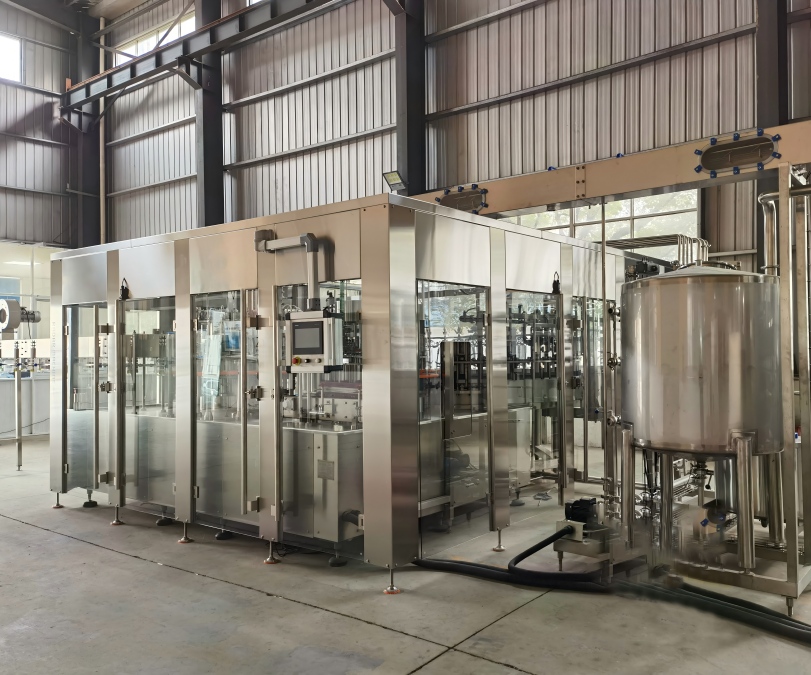
Two Ways to Fill a Bottle
Every drink filling line uses one of two methods to get liquid into a bottle: gravity filling or isobaric filling. The difference is simple. Gravity filling lets liquid flow down under its own weight. Isobaric filling balances pressure first, then lets the drink flow in. Which one you need depends on one question: does your drink have bubbles?
Quick Comparison Table
| Gravity Filling | Isobaric Filling | |
|---|---|---|
| Working principle | Liquid flows by gravity into an open bottle | Bottle is pre-pressurized with CO2, then liquid flows in under equal pressure |
| Best for | Still water, juice, milk, oil | Cola, soda water, sparkling drinks, beer |
| Keeps gas in the drink | No. Open filling lets CO2 escape | Yes. CO2 loss stays below 0.5 g/L |
| Typical speed | Very high, up to 30,000+ BPH | High, commonly 2,000-36,000 BPH |
| Equipment cost | Lower | Higher, needs CO2 supply and pressure system |
Gravity Filling Explained
Gravity filling is the oldest and simplest method. The bottle moves under a filling valve, the valve opens, and liquid flows down into the bottle by gravity. When the bottle reaches the right level, the valve closes.
It works well for drinks without gas. Still water, fruit juice, milk, edible oil and many sauces are filled this way. Because there is no pressure and no foam, the filler runs fast and the machine is simple to operate and maintain.
The limitation is clear: the bottle is open to the air. Any carbonation escapes. That is why a gravity water filling machine is the standard choice for still products, but it can never be used for carbonated drinks.
Isobaric Filling Explained
Isobaric filling, also called counter-pressure filling, solves the gas problem. The process has four steps:
- The bottle is rinsed, then pressed against the filling valve to seal it.
- CO2 gas is pumped into the bottle until its pressure matches the pressure in the product tank.
- With pressure equal on both sides, the carbonated drink flows in gently, with almost no foaming.
- The bottle is de-pressurized and moves to capping.
Because pressure is equalized before the liquid moves, the CO2 stays dissolved in the drink. A good counter pressure filling machine keeps CO2 loss below 0.5 g/L. The result is consistent fizz, less product waste, and a longer shelf life.
Isobaric filling is the standard for carbonated drink filling machines. Cola, soda water, sparkling water, carbonated juice and beer all need this method.
How to Choose: 5 Quick Checks
- Is your drink carbonated? If yes, choose isobaric. If it has no gas, gravity is simpler and cheaper.
- What bottles do you use? PET and glass both work with either method. Just match the filling valve size to the bottle neck.
- What capacity do you need? Gravity fillers reach higher speeds. Isobaric fillers cover most needs from 2,000 to 24,000 BPH.
- Do you want one line for many products? Some lines combine both methods, so you can switch from still water to carbonated drinks on the same line.
- What is your budget? Gravity machines cost less upfront. Isobaric machines cost more but protect your gas, which saves money on every bottle.
Frequently Asked Questions
What is the difference between isobaric and gravity filling?
Gravity filling lets liquid flow into an open bottle under its own weight. Isobaric filling first balances the pressure between the bottle and the tank, then lets the carbonated drink flow in without losing CO2.
Can a gravity filler be used for carbonated drinks?
No. The bottle is open to the air, so the CO2 escapes and the drink goes flat. Carbonated drinks need an isobaric, or counter-pressure, filling machine.
Which filling method is faster?
Gravity filling is faster, with some lines above 30,000 BPH. Isobaric filling is a bit slower, but still reaches 2,000 to 36,000 BPH on typical carbonated lines.
Can one line fill both still and carbonated drinks?
Yes. Some filling machines combine both methods, so you can switch between still water and carbonated drinks on the same line.
Pick the Right Filling Machine
JNDTECH designs both gravity and isobaric filling machines, from single fillers to complete turnkey lines. Every line comes with layout design, installation, training and a one-year warranty, backed by 24-hour after-sales support. Contact JNDTECH and we will recommend the right filling method for your product.