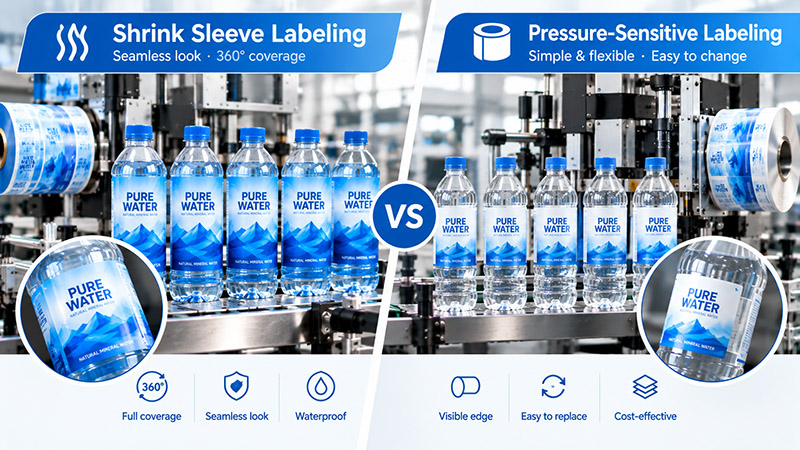
A pressure sensitive label covers a strip of the container. A shrink sleeve covers all of it. That single difference decides more labeling projects than price, speed or supplier do, and it is the first question worth answering.
Shrink Sleeve vs Pressure Sensitive: What Each Method Covers
A pressure sensitive label is pre-coated with adhesive and pressed onto the container by a labeling head. It sits flat on one face, or wraps part of the circumference when a wrap belt is used. It is the same family as the self-adhesive label.
A shrink sleeve is printed on a tube of PVC, PET or OPP film, slipped over the container, and shrunk tight against it by heat. Sleeves come in three formats: full body, neck only, and double head for containers that need both.
| Item | Shrink sleeve | Pressure sensitive |
|---|---|---|
| Coverage | Full body, neck or both | One face or partial wrap |
| Container shape | Any shape, including contoured | Round work best |
| Machine | JND-150 to JND-600 / JND-100 neck | JND-630 / JND-650 |
| Rated speed | 100-12,000 BPH | 2,000-3,200 BPH |
| Label width | 30-250 mm | 10-130 mm |
| Bottle diameter | 20-100 mm | 10-130 mm |
| Extra equipment | Steam or hot air tunnel | None |
| Power | 20 kW | 50 W on JND-650 |
Why Coverage Drives the Choice
Once the label has to reach around a curved surface, along a shoulder, or over a cap, pressure sensitive stops being an option. It cannot follow a compound curve without wrinkling, and a wrinkle on a neck label looks like a defect to a buyer.
A sleeve takes the shape of whatever it is wrapped around. That is why contoured juice bottles, sports cap water bottles and dairy containers use sleeves almost universally, and why the same plants still use pressure sensitive for their plain round lines.
There is a regulatory angle too. Some markets require the full circumference to carry ingredient, origin and warning text. Others require a tamper evident band across the cap. Both push the decision toward a sleeve before cost is discussed.
Speeds and the Shrink Tunnel
Sleeve lines are quoted as a range because the tunnel sets the ceiling. Film needs a set dwell time at temperature to shrink fully, and that dwell time caps how fast bottles can pass through.
Our sleeve range runs from 100 to 12,000 bottles per hour across six models, and the neck sleeve unit covers 3,000 to 9,000 bottles per hour. Rated speed in the table above reflects the machine, not the line: if the tunnel is undersized the line will run slower than the sleeve applicator can deliver.
The tunnel is also the part that catches people out on utilities. A sleeve machine carries 20 kW because it heats the tunnel as well as driving the applicator. A pressure sensitive machine at the same output needs a fraction of that. If power supply is tight at the site, this alone can settle the choice.
Film, Ink and the Cost of a Full Body Label
A sleeve costs more per unit than a pressure sensitive label, and the reason is straightforward: it uses far more material. A full body sleeve on a 500 ml bottle covers several times the surface area of a front label.
The gap narrows when you count what the sleeve replaces. A full body sleeve is the decoration, the back panel, the ingredient block and the tamper seal in one piece, so it removes a second label, a shrink band and the labour to apply both.
Printing method matters here. Sleeves are printed gravure or digitally on flat film before seaming, which handles photographic artwork and multiple colourways well. Short runs still carry plate or setup cost, so a sleeve is a weak choice for products reprinted in small batches.
Which Containers Need a Sleeve
Three answers settle shrink sleeve vs pressure sensitive, in this order.
Is the container anything other than a plain cylinder? A shoulder, a grip panel or a square body rules out a flat label and points to a sleeve.
Does the label have to cover the whole surface? Full body decoration, a mandatory ingredient panel or a tamper evident cap band all require a sleeve.
If the answer to both is no, pressure sensitive wins on cost and on line simplicity. Our pressure sensitive labeling machine applies a label to a round bottle with plus or minus 1 mm placement accuracy and needs no tunnel. If the answer to either is yes, compare the sleeve models in shrink sleeve labeling machines.
Cost structure is the other half of this decision, covered in self-adhesive against hot melt glue labeling. Pressure sensitive labels are also listed under sticker labeling machines.
Frequently Asked Questions
When is a shrink sleeve worth the extra cost?
When the container shape or the labelling requirement rules out a flat label: contoured bodies, full body decoration, mandatory full circumference text, or a tamper evident band over the cap.
Can a sleeve be applied faster than a pressure sensitive label?
Machine ratings overlap. Our sleeve range reaches 12,000 bottles per hour at the top end, while pressure sensitive models are rated 2,000 to 3,200. In practice the shrink tunnel dwell time sets the real line speed.
Does a sleeve always need a steam tunnel?
Not always. Hot air tunnels are used where steam supply is impractical, and they avoid a wet surface after shrinking. Steam remains more common because it transfers heat faster and gives a tighter finish.
What containers cannot take a pressure sensitive label?
Those with a pronounced shoulder, a deep grip recess, a heavily textured surface, or a surface that stays cold and wet. Condensation under the label is the most common cause of edge lifting.