Distilled Water Machine | JNDTECH
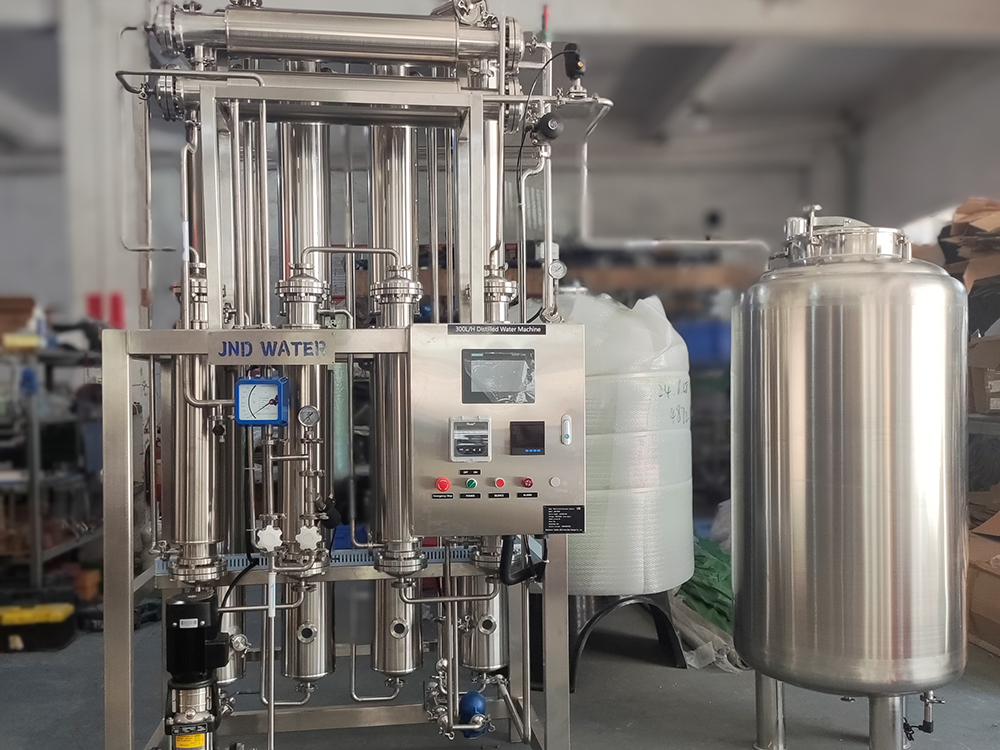
Industrial distilled water machine from JNDTECH, built in five capacities from 300 to 2,000 L/h. The JND series runs on steam at 0.325 MPa and a distillation temperature of 95 to 99 degrees Celsius, with power from 0.75 to 1.5 kW and a distillate conductivity below 0.1 microsiemens per centimetre.
| Output: | 300-2000LPH |
|---|---|
| Power Supply | AC220V380V/415V±5% 50Hz/60Hz |
Product Description
Industrial Distilled Water Machine from 300 to 2,000 L/h
A distilled water machine boils the feed water and condenses the vapour. Inorganic salts, bacteria and most organic matter stay behind in the boiling chamber, so the condensate holds a purity that sediment filters and carbon filters cannot reach on their own.
JNDTECH builds the JND series in five capacities from 300 to 2,000 litres per hour. All five run at a distillation temperature of 95 to 99 degrees Celsius and a steam pressure of 0.325 MPa, so the choice comes down to output and floor space rather than to water quality.
How a Water Distiller Machine Produces Purified Water
The water distiller machine works on a difference in boiling point. Water turns to vapour below the temperature at which dissolved salts and suspended solids do, so the vapour leaving the boiling chamber is clean before it is condensed.
- Preheating. Feed water passes a heat exchanger on the way in, where outgoing distillate and waste heat raise its temperature before it reaches the evaporator.
- Evaporation. The preheated water enters the evaporator at 95 to 99 degrees Celsius. Steam at 0.325 MPa heats it through the wall and the water boils into vapour.
- Condensation. Vapour passes a condenser, where it gives up its heat and returns to liquid form. The impurities left behind in the evaporator are drained off as blowdown.
- Collection. The condensate flows to a storage tank or straight into the process line, held at the purity the plant requires.
Single-Effect and Multi-Effect Distillation
A single-effect unit uses the steam once. The vapour that leaves the evaporator is condensed and the heat is lost, which gives the simplest layout and the highest steam use per litre of distillate.
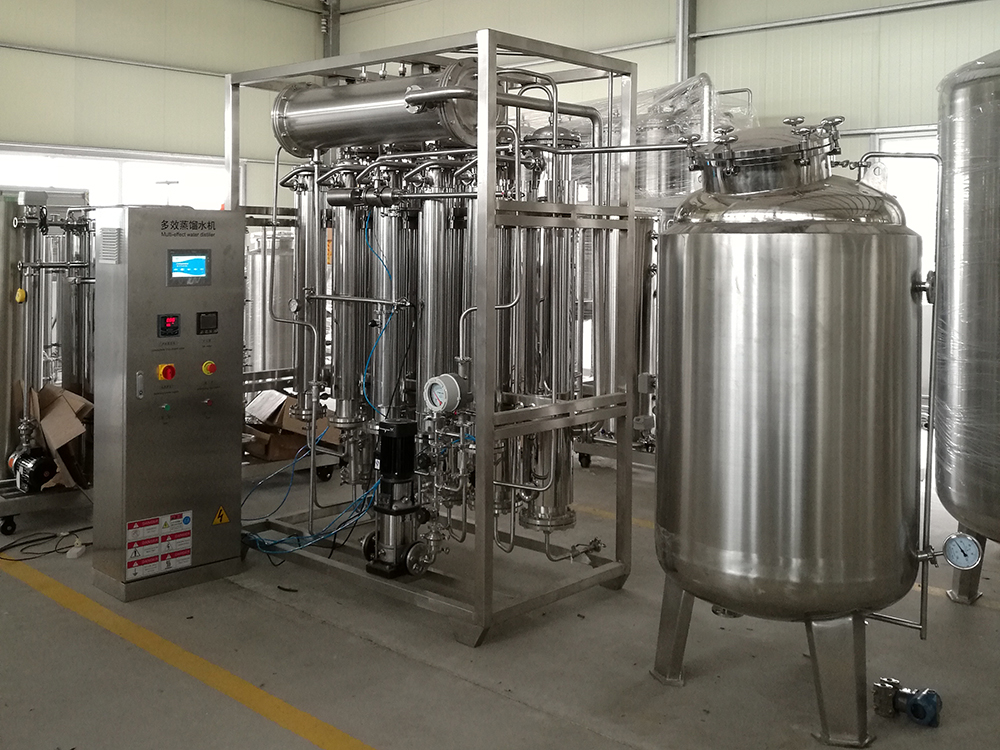
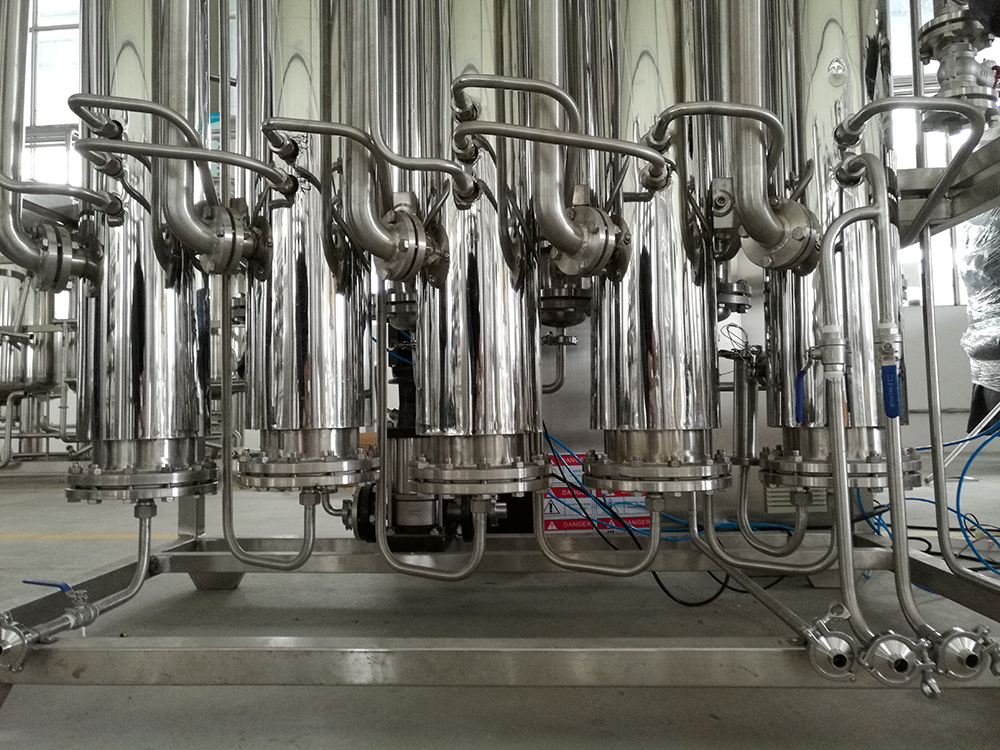
A multi-effect arrangement chains several evaporators together. The vapour from the first effect heats the second, and the vapour from the second drives the third. The same kilogram of steam produces water several times over, so consumption per litre falls as the number of effects rises.
| Item | Single-effect | Multi-effect |
|---|---|---|
| Steam use | Steam used once per litre produced | Vapour reused across stages |
| Energy cost per litre | Highest | Lower |
| Typical use | Clinics, laboratories, small workshops | Pharmaceutical, electronics, food and power plants |
Send us the steam pressure your boiler holds and the volume you need per day, and we will confirm which arrangement fits.
Distilled Water Machine Specifications
| Item | JND-50-RO | JND-100-RO | JND-1000-RO | JND-1500-RO | JND-2000-RO |
|---|---|---|---|---|---|
| Capacity (L/h) | 300 | 500 | 1000 | 1500 | 2000 |
| Distillation temperature | 95 - 99 degrees Celsius | ||||
| Steam pressure | 0.325 MPa | ||||
| Steam consumption | 125 / 500 g/h | ||||
| Feed water (L/h) | 315 | 550 | 1050 | 1575 | 2100 |
| Water quality | Feed water in, pure water out | ||||
| Power | 0.75 kW | 0.75 kW | 0.75 kW | 1.1 kW | 1.5 kW |
| Dimension (mm) | 1450 x 600 x 2450 | 2000 x 850 x 2800 | 2300 x 950 x 3000 | ||
Power supply is AC 220V, 380V or 415V with 5 percent tolerance at 50 or 60 Hz.
Water Quality and Where Distilled Water Is Used
The condensate holds a conductivity below 0.1 microsiemens per centimetre, well under the limit set for purified water in the pharmacopoeia. The evaporator and condenser are built in stainless steel, and the design follows GMP requirements so the unit can be cleaned in place.
Hospitals use distilled water for steriliser feed and instrument rinsing, pharmaceutical plants for injection preparation and equipment cleaning, and electronics factories for component rinsing, where dissolved salts would leave residue on the part. Food and beverage plants use it as an ingredient and as cleaning water, and power plants use it as boiler make-up water, where scale and carryover are the main concern.
Feed water is normally pretreated first. A reverse osmosis unit or an EDI system ahead of the distillation unit cuts scale in the evaporator and extends the interval between cleanings.
Why Choose JNDTECH
- Since 2008, with more than 9,000 machines delivered to 450 factories in 125 countries.
- Supplied as a unit or as part of a full water treatment train, sized to your steam supply and daily volume.
- Installation, commissioning and operator training handled by our engineers on site.
- 1 year warranty and a 24 hour response line.
- ISO 9001, CE and patented designs.
Frequently Asked Questions
What purity does the distilled water machine reach? Conductivity stays below 0.1 microsiemens per centimetre. Send your target specification and we will confirm the unit against it.
Does it need a steam boiler? Yes. The JND series runs on steam at 0.325 MPa. Where a plant has no steam supply, we quote an electrically heated unit instead.
How much feed water does it need? From 315 L/h on the 300 L/h model to 2,100 L/h on the 2,000 L/h model. The gap between feed and output leaves as blowdown carrying the removed salts.
How is this different from reverse osmosis? A reverse osmosis system pushes water through a membrane and rejects most dissolved salts but not all dissolved gases. Distillation leaves both behind in the boiling chamber, so it reaches a higher purity where the specification demands it.
Request a Quotation
Send the litres per hour you need, a feed water analysis and the steam pressure available in your plant. We will confirm the model, the pretreatment train and the price.
Contact JNDTECH for a quotation, or send the details by WhatsApp. We reply within 24 hours.