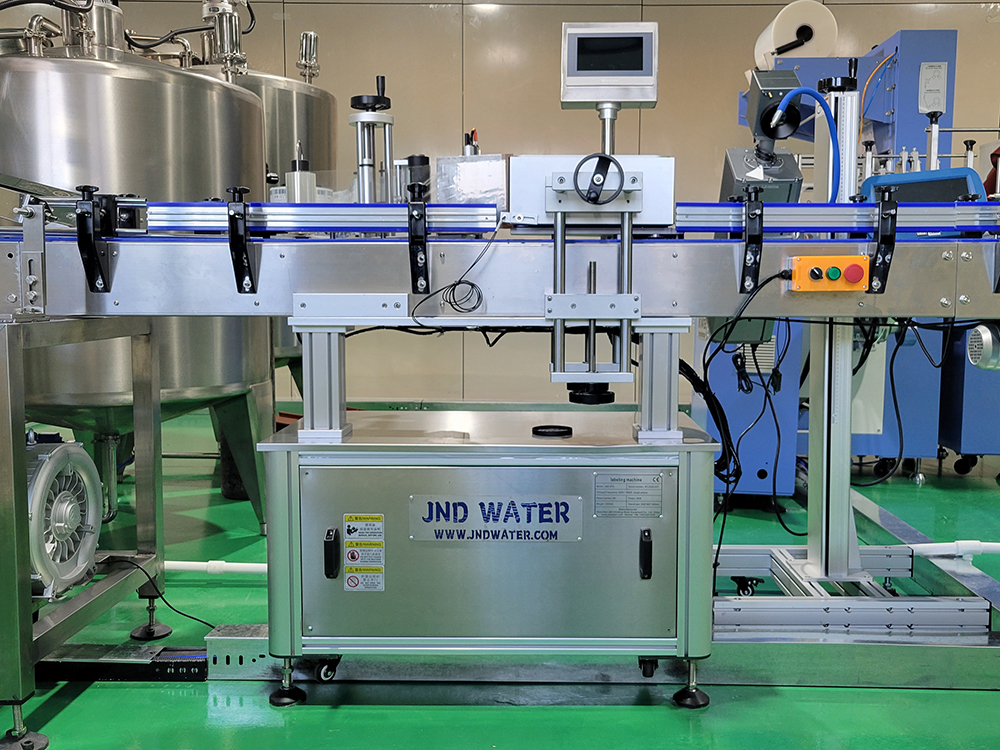
JNDTECH bottle labeling machine is chosen by three things: whether your bottle is round or shaped, how many bottles you run per year, and whether the label has to wrap the whole container. Price follows those answers. Four methods cover almost every bottled water and beverage line, and each one fails in a different place.
Types of Label machine

Cold-glue labeling machine

Hot-melt labeling machine

Sleeve labeling machine

Self-adhesive sleeve labeling machine
The Four Methods at a Glance
The four methods are self-adhesive, hot melt glue, cold glue and shrink sleeve. They are not ranked by quality. Each one is built around a different label material, and the material decides what the machine can do.
| Method | Label material | Best fit | Output range |
|---|---|---|---|
| Self-adhesive | Pre-glued paper or film on a reel | Several bottle shapes on one line | 2,000-8,000 BPH |
| Hot melt glue | OPP film glued on the machine | High volume round bottles | 9,000-21,000 BPH |
| Cold glue | Paper with starch adhesive | Glass bottles, one product all year | 3,600-30,000 BPH |
| Shrink sleeve | PVC or PET film, heat shrunk | Shaped bottles, full-body label | 2,000-12,000 BPH |
None of the four answers every case, so the next three questions narrow the field to one.
Three Questions That Decide the Choice
Is the container round or shaped? A bottle labeling machine holds round bottles against a fixed head without special tooling, because they roll into position and stay there. Square, oval and contoured bottles do not. They need a wrap-around belt system or a sleeve, and that decision comes before price.
How many containers a year, and how many different ones? Volume alone points to hot melt glue. Volume plus frequent bottle changes points to self-adhesive, because swapping a reel takes minutes while changing a glue drum can take hours.
Does the label have to wrap the whole container? A pressure sensitive label covers one face. A shrink sleeve covers 360 degrees and can add a tamper-evident band at the neck. Your market's labeling rules usually answer this one for you.
Changeover time, not the purchase price, is where most of these lines lose money over five years.
Self-Adhesive and Hot Melt Glue Labeling
Self-adhesive labeling machines apply pre-glued labels from a reel. Nothing is glued on the machine, so there is no glue temperature to hold and no glue pot to clean. Changeover is a reel swap and a sensor adjustment, which is why plants running several bottle shapes on one line usually pick this method. Our self-adhesive sticker labeling machine runs round, square and flat containers in three models, from JND-100 to JND-300.
Hot melt glue labeling machines melt an OPP film and apply it with a glue roller and a cutting drum. The film costs less per square meter than a pressure sensitive reel, and the machine runs faster. The trade is setup, because the drum is built for one label size and a new label shape means a new drum. The OPP hot melt glue labeling machines in our range cover round PET and glass bottles at high output.
Cold Glue and Shrink Sleeve Labeling
Cold glue labeling machines use paper labels and a starch adhesive. That adhesive is the cheapest of the four, which is why cold glue still holds the high-volume glass bottle lines. Cutters, label magazines and a gluing station take time to set, so the method suits a plant that runs one bottle for months rather than weeks. See the cold glue labeling machines we build.
Shrink sleeve labeling machines print on PVC or PET film, wrap the sleeve around the container and shrink it in a steam tunnel. The label covers the full body, follows any bottle profile and can add a tamper-evident band at the cap. Film costs more than paper and the tunnel needs steam or power, but no other method decorates a shaped bottle as cleanly. Our shrink sleeve labeling machine covers this family, and the shrink sleeve labeling machines page lists the full range.
Matching Labeling Speed to Your Line
Labeling speed is quoted in two units, and mixing them causes expensive mistakes. BPM means containers per minute. BPH means containers per hour. One machine quoted at 350 BPM is the same machine as one quoted at 21,000 BPH.
Match the bottle labeling machine to the filling machine, not to the plant total. A line running 12,000 BPH needs a labeling machine rated above that figure, with headroom for stops, because it cannot catch up once the conveyor backs up.
If your output is quoted in BPH, convert before you compare quotes. A supplier quoting BPM will look sixty times faster than one quoting BPH for exactly the same machine.
Frequently Asked Questions
Which method costs the least to start?
Self-adhesive. The machine is simpler, the labels arrive pre-glued, and there is no glue system to install.
How many labeling machines does one filling line need?
One for most lines. Two only when the front and back labels go on separately at high speed.
How long does a bottle changeover take?
On a self-adhesive machine, a reel swap and sensor adjustment take under an hour. On a hot melt or cold glue machine, a label size change can take most of a shift.
Can these machines label shaped bottles?
Self-adhesive handles flat and slightly curved faces. For a shaped bottle with a full-body label, shrink sleeve is the practical answer.
Tell us your bottle shape, your output and whether the label wraps the whole container. JNDTECH will tell you which of the four methods fits and what it costs.