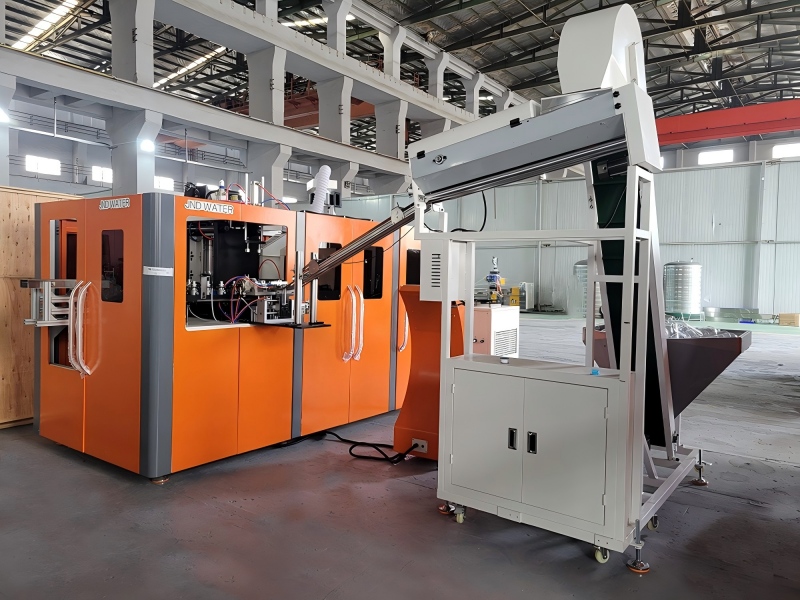
A PET blow molding machine turns heated PET preforms into finished bottles. Choosing one comes down to three numbers and one decision: how many bottles per hour your filler needs, how many cavities that requires, and whether you run semi-automatic or fully automatic. Get the capacity right and everything else follows; get it wrong and you either starve your filling line or pay for speed you never use.
This guide walks through the sizing logic we use with buyers, using the real specifications of our PET blow molding machine range as worked examples.
What a PET Blow Molding Machine Actually Does
A preform — a small, thick-walled PET test tube — is heated in an infrared oven until it becomes soft, then clamped inside a mold and stretched, first mechanically by a stretch rod and then by high-pressure air, until it takes the shape of the mold cavity. The bottle is cooled, ejected, and sent to the filler.
Two process details matter when you compare machines. First, preform heating must be even: uneven heating is the single biggest cause of thin walls, pearlescent patches and burst bottles, which is why infrared ovens use individually controlled lamp zones and reflective shields rather than one blanket heater. Second, how the machine is driven decides your utility bill and your maintenance load. Servo-driven machines control clamping, stretching and transfer electrically, so they need no shop-air compressor at all. Pneumatic machines are cheaper to buy and cost more to run.
Semi-automatic machines keep the operator in the loop for loading preforms and removing finished bottles; heating and blowing stay automatic. Fully automatic machines run preform feeding, heating, blowing and ejection without an operator touching the machine. The gap in output between the two is an order of magnitude — from roughly 90–120 bottles per hour on a single-cavity semi-auto up to 15,000 BPH on a ten-cavity servo machine.
Size the Machine to Your Filler, Not the Other Way Around
The most common and most expensive mistake is buying a blow molder that cannot keep up with the filling line it feeds. Your sizing starts at the filler, not at the blower.
Work backwards in three steps. (1) Find your filler's rated capacity — say a 3-in-1 bottled water filler rated at 6,000 BPH. (2) Add a buffer for downtime. Blow molding and filling rarely stop at the same moment, so size the blower at roughly 105–115% of filler capacity if you run them in parallel, or 100% if the blower feeds a silo or accumulator that decouples the two. (3) Check the bottle format, because rated capacity is always quoted at a reference bottle — usually 500 ml. Larger bottles run slower; a machine rated 12,000 BPH at 500 ml will not hit that figure at 2 L.
| Filler capacity | Blow molder guidance | Realistic configuration |
|---|---|---|
| Under 1,000 BPH | Semi-auto, single cavity | 90–120 BPH for 5-gallon barrels; 800–3,000 BPH per cavity for small bottles |
| 2,000–4,000 BPH | Small automatic | Compact automatic, 2–4 cavities |
| 6,000–12,000 BPH | High-speed automatic | 8-cavity servo, 10,000–12,000 BPH at 500 ml |
| 13,000 BPH and above | High-speed automatic | 10-cavity servo, 13,000–15,000 BPH at 500 ml |
If you are still choosing the filler itself, size both together — a mismatch in either direction wastes capital.
How Many Cavities Do You Actually Need?
Cavity count is the number of bottles a single heating and blowing cycle produces at once, and it is the main lever on output. More cavities means more output per cycle, but also more mold cost, more compressed-air demand per cycle and a bigger footprint.
For scale: our 8-cavity fully automatic PET machine produces 10,000–12,000 BPH at 500 ml on roughly 48 kW, while the 10-cavity model reaches 13,000–15,000 BPH on roughly 62 kW. Both run the same 0.2–2 L bottle range and both are full-electric servo, so the step up in output does not change the way the machine is operated or maintained.
Two practical constraints usually decide the answer. First, mold cost and changeover: every cavity needs its own mold, and each bottle shape needs its own set. A ten-cavity machine running four SKUs means four ten-cavity mold sets. Second, shop air: high-cavity pneumatic machines need a large compressor and booster; servo machines remove that requirement entirely, which frequently tips the decision on total cost rather than purchase price.
If your demand is seasonal or your SKU list is long, fewer cavities with more mold changes is often the better trade. If you run one bottle shape at volume, cavities are the cheapest capacity you can buy.
Semi-Automatic vs Fully Automatic: The Real Decision
This is the choice buyers agonize over, so treat it as a throughput-and-labour calculation rather than a preference.
Choose fully automatic when you need continuous output above a few thousand BPH, when labour is expensive or hard to retain, or when bottle consistency matters commercially. The servo drive removes the shop-air compressor from your utility load, and one operator can supervise the whole line rather than standing at the machine. Mold changes take 20–30 minutes, so multi-SKU production is still practical.
Choose semi-automatic when daily volume is low, when you are making large-format containers such as 18.9 L (5-gallon) barrels, or when you are starting up and capital discipline matters more than labour cost. Our semi-automatic blow molding machine range covers 0.2–20 L at 800–3,000 BPH per cavity with manual preform loading and bottle take-out. The 5-gallon unit is a good illustration of the trade-off: a single cavity producing 90–120 barrels per hour, about 2.5 kW of power, blowing at 2.0–3.0 MPa, on a footprint of roughly 1.6 × 0.7 × 1.8 m and about 500 kg — small enough for a village water station, and it needs both a low-pressure compressor and a high-pressure booster, which the automatic servo machines do not.
One caveat worth planning for: two semi-automatic machines do not equal one automatic machine. Manual loading sets a hard ceiling on cycle consistency, and the labour does not scale away as volume grows. If you expect to exceed roughly 1,000 barrels a day within two years, model the automatic option now.
Which Bottles and Materials Must the Machine Handle?
Bottle format drives mold design, oven settings and blowing pressure, so list every bottle you intend to make before choosing a machine — including the ones you plan to add next year.
Still water and purified water bottles are the simplest case: 0.2–2 L, thin walls, modest blowing pressures — this is what our water bottle blowing machine is sized for. Carbonated soft drink bottles are the opposite: they must hold 4–5 atmospheres of internal pressure, which puts the emphasis on neck-thread precision and wall-thickness distribution rather than on raw speed. Hot-fill bottles for juice and tea need a heat-setting process instead — neck crystallisation and molds heated to roughly 120–140 °C — so a machine bought for cold-fill water cannot simply be retooled for hot fill. Edible oil bottles from 375 ml to 10 L are a barrier and oil-resistance question. Cosmetic, pharmaceutical and detergent containers add shape complexity and, in some cases, one-step injection-stretch-blow machines to avoid intermediate contamination.
A single platform can cover more than one of these. Our fully automatic machines run the 0.2–2 L range — water, CSD, juice, edible oil and detergent — by changing the neck and body molds only, with no major rebuild. For the full taxonomy of formats a PET machine can produce, including square, oval and irregular shapes, see our guide to bottle types a PET blow molding machine can produce.
Specs to Confirm Before You Place a Deposit
Vague quotations are the main source of disappointment, so ask for these in writing and match them against your own bottle drawings.
- Rated capacity and the reference bottle. Always "X BPH at Y ml". Without the bottle size, the number is meaningless.
- Bottle range in both volume and maximum height, and the neck diameters supported.
- Cavity count, and the cost of an additional mold set in your bottle shape.
- Blowing pressure and working pressure (for example 2.0–3.0 MPa blowing, 0.8–1.0 MPa working) — this determines whether you also need a high-pressure booster.
- Total connected power, which sets your transformer and cabling, not just your electricity bill.
- Footprint and weight, checked against the actual floor you have and how you will get the machine through the door.
- Drive type — full-electric servo versus pneumatic — and whether a shop-air compressor is required.
- Scrap rate at rated speed. A machine claiming under 0.5% defective bottles is making a testable promise; ask how it is measured.
- Mold change time, if you run more than one bottle shape.
- Certification and documentation — CE and ISO9001 — plus the spare-parts list and lead time for wear items.
Bring your preform spec and your target bottle to the quotation stage. A supplier who asks for both is sizing your line; one who quotes from a capacity figure alone is guessing.
How the Blow Molder Fits Your Complete Line
The blow molder is the front of a chain, and buying it in isolation creates integration problems that cost more than the machine. Upstream, you need water treatment and a preform supply decision — buy preforms or run your own injection molding. Downstream, bottles flow to the filler, then the labeler, then packaging.
That downstream half is where lines lose money quietly. Bottles arriving at the filler out of orientation stop the line; finished packs that cannot be palletised tie up labour at the end of the shift. Our packing machine range covers carton, shrink and stretch-film formats, and the palletizer range covers both robot and gantry configurations for the end of the line.
Two design questions decide whether the chain runs smoothly. First, buffering: is there an accumulator between blowing and filling, or are the two machines bolted directly together so that a stop in either halts both? Second, orientation and conveying: the blow molder's output must reach the filler in the orientation the filler expects, which usually means an air conveyor matched to the filler's infeed rather than a generic belt.
JNDTECH builds blow molders and the filling, labeling and packaging machines that follow them, so the interfaces are designed together rather than discovered on site during commissioning — including layout drawings that show how the machines actually connect.
Frequently Asked Questions
How many BPH do I need from a blow molding machine? Start from your filler's rated capacity at your reference bottle size, add 5–15% if the two machines run in parallel without a buffer, and confirm the figure is quoted at your bottle volume. A 6,000 BPH filler typically pairs with an 8-cavity automatic machine for 500 ml water bottles.
Do fully automatic PET blow molding machines need an air compressor? No. Full-electric servo machines drive clamping, stretching and transfer electrically, so there is no shop-air load. Semi-automatic machines do need compressed air — both a low-pressure supply and, for thick-walled formats such as 5-gallon barrels, a high-pressure booster up to about 3.0 MPa.
Can one machine make both still water and carbonated bottles? Often yes, within the same volume range — the 0.2–2 L platform covers water, CSD, juice, edible oil and detergent by changing molds. Carbonated bottles, however, demand tighter neck-thread precision and wall distribution because they must hold 4–5 atmospheres, so confirm CSD capability explicitly rather than assuming it from a volume range.
How long does a mold change take? On a modern automatic machine with quick-change neck and body molds, a bottle shape swap takes roughly 20–30 minutes, which makes multi-SKU production practical on a single unit.
Semi-automatic or fully automatic for a new water plant? If your daily requirement is below roughly 1,000 barrels or bottles and capital is tight, semi-automatic gets you producing for the lowest investment and is easy to operate and maintain. If you expect to exceed that within two years, price the automatic machine now — two semi-auto units are not equivalent to one automatic unit, because manual loading caps cycle consistency and labour does not scale away.
What is the largest bottle a PET blow molding machine can produce? It depends on the machine class rather than the material. Semi-automatic ranges commonly reach 20 L, covering 5-gallon (18.9 L) barrels and large edible-oil containers, while high-speed automatic machines are usually optimised for the 0.2–2 L beverage range.
Ready to size a blow molder against your filling line? Send us your target bottle and required output, and we will come back with a matched configuration and layout.