Distilled water vs reverse osmosis water is usually framed as a question of which one is purer. That framing sends buyers down the wrong path. One method is a phase change, the other a membrane step, and the gap between them shows up in capital cost, running cost and what the downstream equipment has to cope with.
Distilled Water vs Reverse Osmosis: What Actually Differs
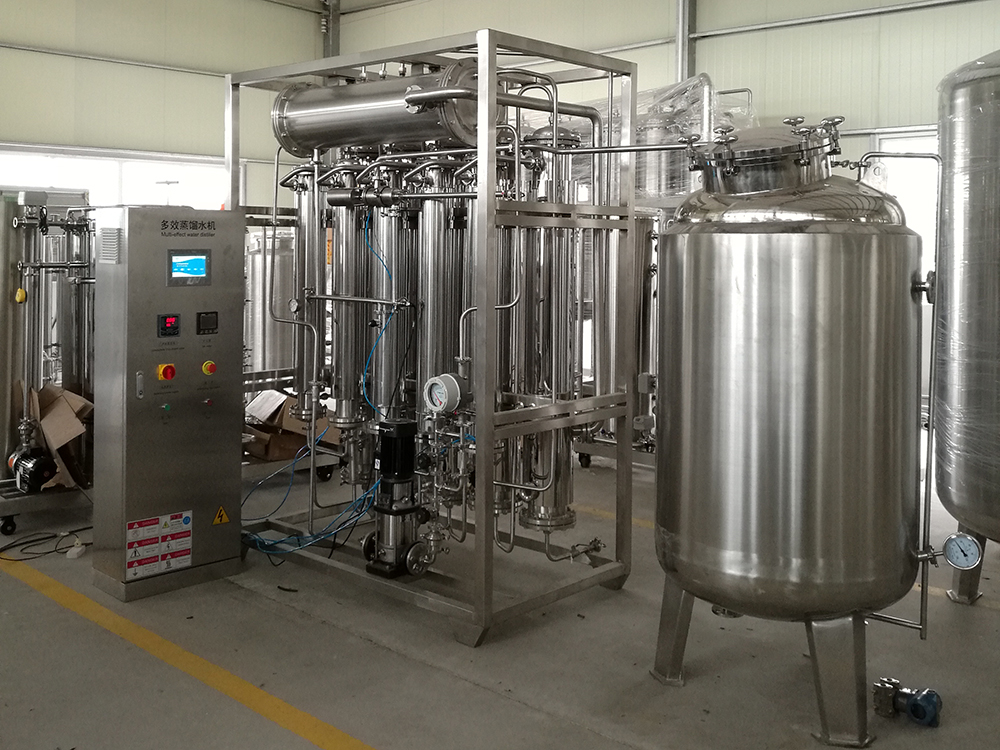
The difference starts at the mechanism. A distilled water machine boils feed water and condenses the vapour, so salts, bacteria and most organic matter stay in the boiling chamber. Reverse osmosis forces raw water through a semi-permeable membrane under pressure; dissolved salts leave in the concentrate stream.
One separates by boiling point, the other by pressure. Both remove dissolved solids, but they do not reach the same purity or cost the same to run.
What Each Method Removes
Both routes take out the bulk of dissolved salts. The differences that matter sit below that line.
Distillation leaves essentially all non-volatile material in the evaporator. The JND condensate holds a conductivity below 0.1 microsiemens per centimetre, the band used for injection preparation and electronics rinsing. Bacteria and endotoxins stay with the salts.
A reverse osmosis membrane rejects 98 percent or more of dissolved salts, and bacteria leave with the concentrate. It does not strip dissolved gases, and feed water above 1,000 microsiemens per centimetre sits outside the standard envelope.
| Item | Distilled water | Reverse osmosis permeate |
|---|---|---|
| Dissolved salts | Left in the boiling chamber | 98 percent or higher rejected |
| Conductivity | Below 0.1 microsiemens per centimetre | Depends on feed water |
| Bacteria | Left behind | Rejected with the concentrate |
| Endotoxins | Not carried into the vapour | Not reliably rejected |
| Dissolved gases | Stripped during boiling | Pass through the membrane |
Output Range, Steam and Footprint
Output range separates the two more clearly than purity. Distillation covers 300 to 2,000 litres per hour in five models and stops there. A line needing 10,000 litres an hour will not find a standard still large enough.
Reverse osmosis starts lower and goes much further. The standard build covers 200 to 8,000 litres per hour, and custom builds reach 100,000 litres per hour for large bottling and municipal projects. Only the membrane route scales past a few tonnes an hour.
Distillation also asks for steam: the JND series runs on steam at 0.325 MPa and boils at 95 to 99 degrees Celsius, so a plant without a boiler adds one to the budget. Reverse osmosis needs power only, but holds water at 0.7 to 1.5 MPa.
| Item | Distilled water machine | Reverse osmosis equipment |
|---|---|---|
| Output | 300 to 2,000 L/h, five models | 200 to 8,000 L/h standard, custom to 100,000 L/h |
| Utility | Steam at 0.325 MPa | Power only |
| Power | 0.75 to 1.5 kW | Scales with membrane count |
| Footprint | 1,450 x 600 x 2,450 mm upward | Skid mounted |
What Each Litre Costs to Make
No cost per litre survives contact with your plant. It moves with what you pay for electricity and steam, how close you run to rated volume, and how hard your feed water is.
Distillation converts energy into a phase change, so the energy term is large and fairly fixed. Multi-effect designs cut it by reusing vapour across stages, which is why single-effect against multi-effect matters more than the model number.
Reverse osmosis spends its energy on pressure, and the second large term is membrane replacement. Feed water harder than expected shortens membrane life faster than any other factor. A water analysis beats a discount on the skid.
Three Questions That Decide It
How pure does the water have to be? For bottled drinking water, permeate is the normal answer. For injection preparation, electronics rinsing or high pressure boiler make-up, distillation is.
How much do you need per hour? Below about 2,000 litres, both are in range and running cost decides. Above it, distillation becomes custom work.
What is your feed water? Reverse osmosis holds inside 1 to 45 degrees Celsius, pH 2 to 11 and conductivity at or below 1,000 microsiemens per centimetre. Mains, well and river water fall inside it. Saltier sources belong on seawater desalination equipment; smaller shops are better served by commercial reverse osmosis equipment.
When the Answer Is Both
In pharmaceutical and electronics plants the answer is usually a chain, not a choice. Reverse osmosis handles the volume and strips the bulk of the salts, then an EDI water treatment stage or a distillation unit takes the permeate to final purity.
Running the membrane first changes the economics of the still: scale builds slower and the cleaning interval lengthens. Put reverse osmosis water treatment equipment ahead of the distilled water machine and the still only has to remove what the membrane could not.
Read the other way round, the chain fails. Distillation first spends steam on water the membrane would have handled anyway.
Frequently Asked Questions
Is distilled water purer than reverse osmosis water?
On conductivity, yes. The JND series measures below 0.1 microsiemens per centimetre, while permeate depends on feed water. For injection preparation and electronics rinsing that gap decides it.
Can reverse osmosis water replace distilled water in a laboratory?
For most uses, yes. Where a protocol calls for water free of endotoxins or dissolved gases, distillation is the safer route, because a membrane alone does not remove both reliably.
Which is cheaper to run?
Neither, in general. Distillation carries a large energy term that multi-effect reduces; reverse osmosis carries membrane replacement that feed water drives. Compare them on your own utility prices.
Can a plant run both?
Yes, and many do. Reverse osmosis as pre-treatment cuts scale in the evaporator and stretches the cleaning interval, which is the usual reason the two are specified together.