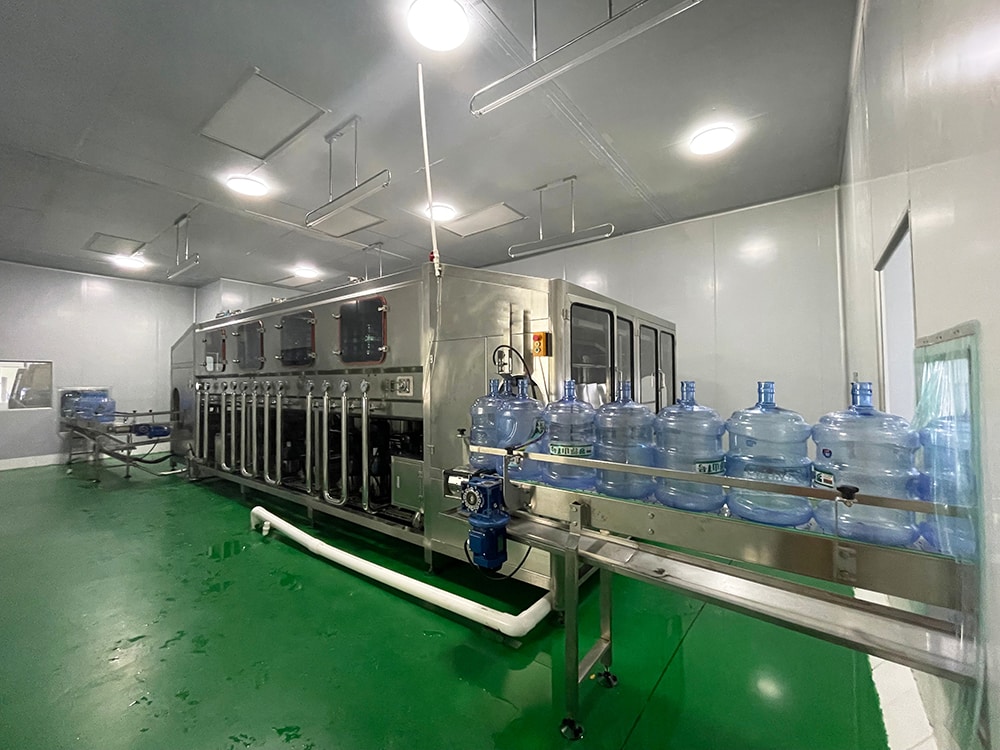
A 5-gallon filling line differs from a small-bottle line in one respect that governs the rest of the design: the bottles come back. Each one is refilled several hundred times before retirement, and it returns scratched, soiled or cracked. The line has to be specified for the worst bottle in a stack rather than the best, which is why two plants with the same daily output can run entirely different equipment.

Size the line from daily volume, not from the brochure
Suppliers quote output in bottles per hour, a maximum under ideal conditions. Work backwards from the volume you actually ship.
| Bottles per day | Output required (8h shift) | Typical configuration |
|---|---|---|
| Under 500 | 60–100 BPH | Semi-automatic line, 3–4 operators |
| 500–2,400 | 100–300 BPH | Semi-automatic or entry-level automatic line |
| 2,400–8,000 | 300–1,000 BPH | Automatic washing-filling-capping monobloc |
| Over 8,000 | 1,000–2,000 BPH | High-speed automatic line with palletizing |
Sizing for volume that has not been sold. A 1,000 BPH line running at 30 percent still carries the maintenance, spares and depreciation cost of a 1,000 BPH line.
Treating an eight-hour shift as eight productive hours. Changeovers, cleaning, breaks and the washing cycle consume time. Plan on six productive hours, which can move the requirement up a capacity tier.
The washing section sets your real throughput
In a returnable-bottle plant, the washing machine governs throughput, water quality and maintenance cost, whatever the filling machine is rated at. Returned bottles include units stored in sunlight and units with hairline cracks that inspection cannot reliably catch. A filling machine rated at 600 bottles per hour will not exceed 400 if the 5-gallon water filling line behind it cannot keep pace, or if it keeps pace only by shortening the rinse stage that makes the bottle safe.
Practical rule: the washing machine's rated output should exceed the filling machine's by 10 to 15 percent. Where a quotation shows identical figures for both, ask how that is achieved.
Most 5-gallon washing machines run three to five stages: pre-rinse, alkaline wash, disinfectant, and a final rinse with treated water. More stages is not automatically better, since each adds water consumption, chemicals, pumps and maintenance points. What matters is whether the stages address your conditions.
- Return cycle. Bottles refilled the same day require less than bottles stored for a month.
- Water chemistry. High mineral content places greater demand on the final rinse, or bottles show visible spotting.
- Climate. In hot conditions bacterial growth accelerates and the disinfectant stage is not optional.
A five-stage machine quoted without a single question about your bottles or water source is a catalogue selection, not an engineering one.
Semi-automatic or automatic: this is a labour decision
This decision turns on labour cost and labour reliability, not on equipment preference.
| Semi-automatic | Fully automatic | |
|---|---|---|
| Typical output | 60–300 BPH | 300–2,000 BPH |
| Operators per shift | 3–6 | 1–2 |
| Upfront cost | Lower | Substantially higher |
| Consistency | Depends on the operator | PLC-controlled, repeatable |
| Maintenance skill | Basic mechanical | Electrical and PLC knowledge |
| Justified when | Volume is modest and labour is affordable | Volume is steady and labour is expensive or scarce |
Below roughly 500 bottles per day, with dependable staff available, a fully automatic line rarely repays its cost; the investment is justified only when the labour it replaces is genuinely expensive or impossible to recruit. The reverse case is equally common. Where operators are difficult to retain, a semi-automatic line becomes a permanent bottleneck, not because it is slow but because output stops whenever an operator does not appear.
Settle bottle and cap specifications first
- Bottle size. The practical figure is 18.9 litres in most markets and 19 litres in others. Some plants run 3-gallon bottles on the same line. Mixed sizes are feasible with changeover parts, and every changeover reduces effective output.
- Bottle material. Polycarbonate bottles withstand hundreds of cycles and hold their shape; food-grade PET is lighter and cheaper with a shorter service life. The material determines how the bottle is held during washing and the grip pressure the capping machine can apply. Plants producing their own bottles should size a PET 5-gallon bottle blow molding machine to match the line.
- Cap type. Screw caps and press-on caps require different capping heads. Where both flat caps for retail and sport caps for dispenser customers will be run, specify this at the quotation stage.
Steel grade, cleaning and certifications
Every surface in contact with product water should be stainless steel. SUS304 suits most 5-gallon applications; SUS316 justifies its cost where mineral content is high or the water source is aggressive, because it resists the corrosion that eventually pits a 304 surface. Clean-in-place capability matters as well, since a line that is difficult to clean will not be cleaned correctly, and residue left in a filling valve reaches the customer's bottle. CE marking is required for the European market and ISO 9001 covers the manufacturer's quality system. Where local drinking-water regulations apply, identify the requirements before ordering, because retrofitting a machine to a standard discovered late is expensive.
Six questions to ask before paying a deposit
- What is the washing machine's rated output, stated separately from the filling machine's?
- Which changeover parts are needed for a second bottle size, and what downtime does a changeover cost?
- Which wetted components are not stainless steel?
- What is the water consumption per bottle, across all wash stages?
- Which components carry the warranty, and which are treated as consumables?
- Can I speak to a plant currently running this model?
A supplier with reference installations will provide them unprompted.
Frequently asked questions
What capacity does a small water plant need?
Plants filling under 500 bottles per day generally operate on a 60 to 100 BPH semi-automatic line. The common error is specifying for a hoped-for volume rather than current orders.
Can one line fill both 3-gallon and 5-gallon bottles?
Yes, with changeover parts for the bottle guides and capping head. Each changeover stops production, so downtime belongs in capacity planning rather than counting as free flexibility.
How many operators does the line require?
A semi-automatic line needs three to six people per shift for loading, unloading and monitoring the washing section; a fully automatic line runs with one or two.
Is a water treatment system required?
For purified water, yes. The filling machine handles the bottle, not the water. Reverse osmosis, ultraviolet sterilisation and ozone dosing are the standard combination, sized to the filling rate rather than to the storage tank. Commercial RO treatment equipment is matched against the line's hourly demand.
Send your daily bottle volume, bottle size and water source, and JNDTECH will return a line configuration matched to those numbers rather than the largest machine available. JNDTECH builds 5-gallon (18.9L / 19L) filling lines from 60 to 2,000 BPH, semi-automatic through fully automatic turnkey systems, with matched water treatment. For budget planning, see what a water filling line costs.