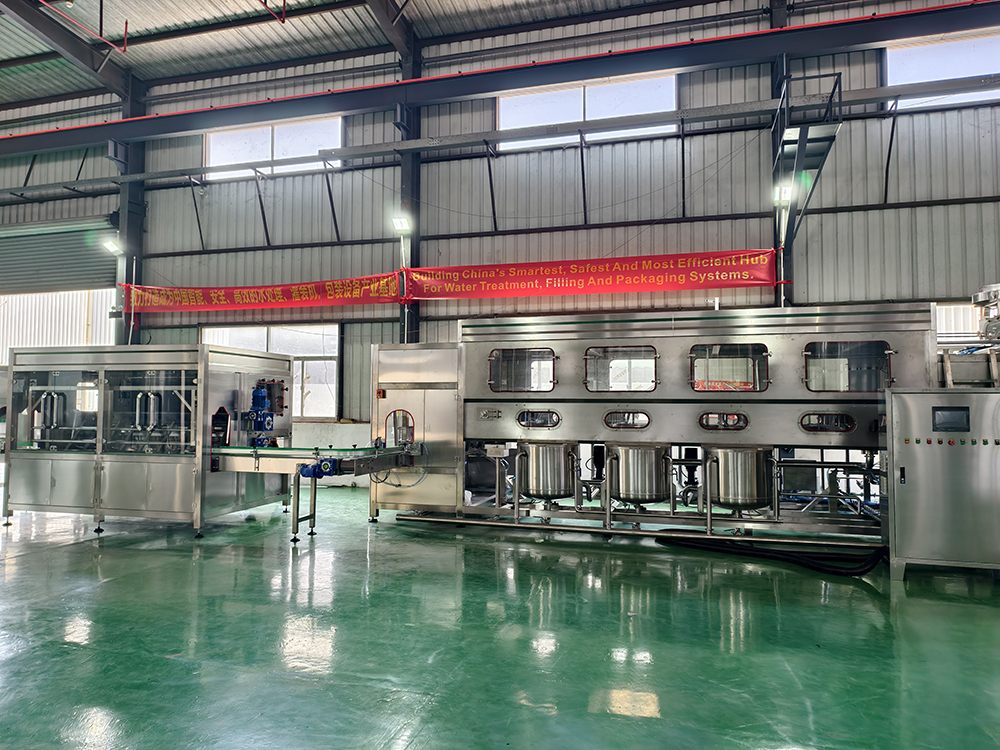
How to start a 5 gallon water business is usually planned backwards. People ask which filling machine to buy. The question that decides whether the plant works is how many barrels you need in circulation, because a 5 gallon plant sells returnable containers, not disposable bottles.
How to Start a 5 Gallon Water Business: Three Decisions First
Three decisions come before equipment: how the barrel loop closes, how much water the source can deliver and what it needs removed, and which capacity tier the market supports today with room to move up.
Get those three in order and the machine list follows. Get them wrong and a correctly sized 5 gallon water filling line sits half idle, waiting for empty barrels that never come back.
What a 5 Gallon Line Actually Consists Of
A barrel water plant is nine stations, not one machine. Two sit upstream and seven on the line itself.
| Station | Function |
|---|---|
| Barrel supply | Purchased returnable drums or a semi-automatic blow molding machine |
| Water treatment | RO or UF system feeding the line |
| Uncapping | Removes the old cap before washing |
| Leak detection | Rejects cracked barrels before filling |
| High pressure washing | Internal and external wash, sanitizing stage optional |
| Filling | Meters 18.9 L per barrel by flow meter or level control |
| Capping | Applies a new cap at controlled torque |
| Sleeve labeling | Branding or tamper evident band |
| Bagging and palletizing | Dust proof bag, then stacked for delivery |
One PLC ties the stations together, so a jam at the leak detector stops the filling machine instead of flooding the floor. Contact parts are SS304 and the line is built for CIP.
Sizing the Line to Your Market
The JND-BWL series runs in three tiers, and the tier sets operators and floor space as much as speed.
| Model | Capacity | Automation | Operators | Footprint |
|---|---|---|---|---|
| JND-120 | 60 to 120 BPH | Semi-automatic | 2 to 3 | 40 to 60 m2 |
| JND-600 | 300 to 600 BPH | Mid-speed, automatic stations | 3 to 5 | 100 to 150 m2 |
| JND-2000 | 1,000 to 2,000 BPH | Fully automatic rotary | 5 to 10 | 250 to 400 m2 |
Typical configurations; final figures follow your layout and options.
A start-up station with low labor cost opens at 60 to 120 BPH. A regional plant selling through distributors lands at 300 to 600. Above 1,000 the line turns rotary, because handling that volume by hand costs more than the automation. The tier is not permanent: semi-automatic layouts carry upgrade paths, so conveyors and stations extend as volume grows.
The Barrel Loop Is Your Real Capacity Limit
This is what separates 5 gallon from bottled water. Every barrel has to come back, be washed, inspected and go out again. The barrel is an asset with a cycle time, and that cycle sets your ceiling.
Run the arithmetic first. A 600 BPH line on one eight-hour shift fills 4,800 barrels a day. At a five-day return you need 24,000 barrels in circulation before you sell the first one, plus a buffer for damaged units.
Two stations protect that investment. Leak detection rejects cracked barrels before they waste treated water and wet a customer's floor. The internal high pressure wash, with optional sanitizing, is what makes a returned barrel safe to refill.
Skip either and the loop breaks, because barrels leave service faster than you replace them. Capping head torque and washing machine intervals matter for the same reason; the line maintenance checklist covers both.
Water Treatment Before the Filling Machine
Treatment is sized to the line, and to more than the filled volume: the wash stations draw treated water too, so capacity must cover filling plus washing. Sized on filled volume alone, the line runs at half speed while the skid catches up.
What the source contains decides the process. Clear municipal supply usually passes through UF; harder or higher TDS water needs the reverse osmosis water treatment equipment. Test first: an analysis costs far less than a skid built for the wrong problem.
What You Can Start Without
Three items can wait. Barrel blowing: buy returnable drums first and add the semi-automatic 5 gallon blow molding machine when volume justifies a second shift. Sleeve labeling: a brand asset, not a production need. Palletizing: manual until the weight becomes a labor problem.
Washing, leak detection and capping cannot wait. Those three decide whether a returned barrel can safely and legally go back out.
What to Get in Writing Before You Order
Five items belong in the quotation: capacity at a stated barrel size rather than a range; the number of wash stages and whether sanitizing is included; leak detector sensitivity; treatment capacity that includes wash water; and a layout drawing against your real building.
Five make an offer you can compare. Three make a price.
Frequently Asked Questions
How much does it cost to start a 5 gallon water business?
No single figure applies. Cost moves with the capacity tier, whether you buy or blow barrels, the treatment your source needs and the building. Ask for line, treatment and barrel supply priced separately, so you can see which part drives the total.
Do I need a blow molding machine to start?
No. Purchased returnable barrels are the normal start, and the line takes a semi-automatic blow molding machine later without rebuilding the conveyor layout.
How many barrels should I buy?
Daily fills multiplied by return days, plus a buffer for damaged units. A 600 BPH line on one shift fills 4,800 barrels a day, so a five-day cycle needs about 24,000.
Can a semi-automatic line be upgraded later?
Yes. The semi-automatic layout carries upgrade paths, and stations plus conveyors extend as volume grows. Ask for that path in writing when you order, not after installation.