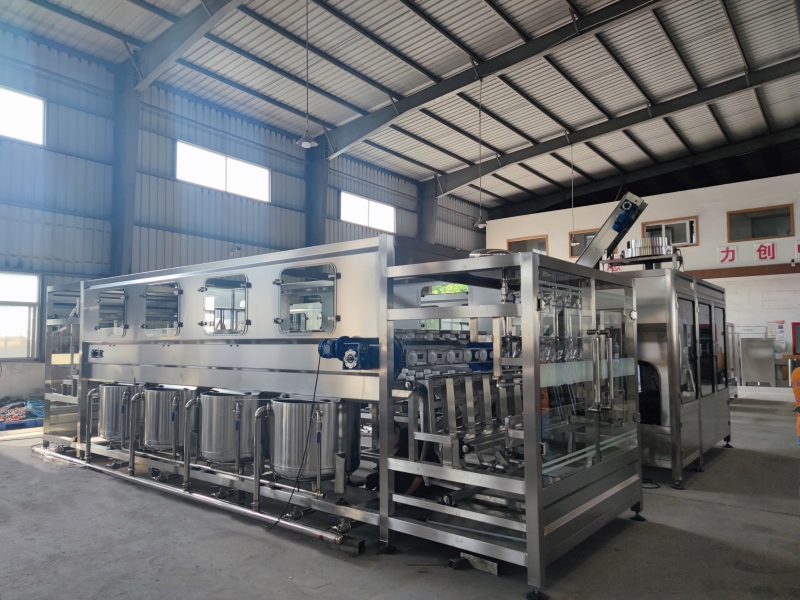
5-gallon water bottling line is a chain of machines: uncapping machine, leak detection, internal and external high-pressure washing machine, filling machine, sleeve labeling machine, bagging machine and palletizer. Line output is set by the slowest unit in that chain, and one worn wear part can move the slowest unit. This checklist is ordered by what actually stops a returnable-barrel line.
Set 5-gallon line intervals in bottles, not in days
Most published maintenance schedules list weekly, monthly and quarterly tasks. That format suits a plant running at one fixed rate. It breaks down across a range that spans 60 BPH to 2,000 BPH, because a component at the top of that range wears at many times the rate of the same component at the bottom.
An interval expressed in bottles processed transfers between machines. The capping head on a JND-120 running at 100 BPH and the capping head on a JND-2000 running at 1,800 BPH both need attention after a comparable number of caps, not after a comparable number of days.
The working method: take the interval your supplier quotes, convert it into bottles, and rebuild the calendar from your own output. A plant running 1,800 BPH on one shift reaches a given bottle count far sooner than a plant running 100 BPH. Identical task, different calendar.
The washing machine hides its own wear
External condition is visible and therefore usually maintained. Internal condition is not, and it is where barrel quality is decided. The multi-stage high-pressure rinse works through nozzles and jets, and hard water deposits scale inside them. Scale narrows the jet, the rinse action weakens, and nothing outside the machine changes.
Two checks catch this. Compare rinse pressure or flow at each stage against the value recorded at commissioning. Verify cleanliness with a rinse-water test rather than a visual look. High mineral content in the water supply should be treated as a schedule driver, with the RO or UF stage sized to line demand and the final rinse drawn from treated water.
Scale is also why a five-stage washing machine is not automatically better than a three-stage unit. More stages mean more nozzles, more pumps and more points to descale.
Capping head and cap seal
Leaking barrels reported by customers usually trace back to the capping head rather than the filling machine. On a 19 liter barrel the cap is approximately 58 mm diameter by 40 mm high, and the seal depends on a compressible pad and a repeatable closing force.
Two things degrade. The pad hardens and takes a permanent set, so it stops compensating for cap tolerance. The closing force drifts as springs, air pressure or mechanical stops wear. The second is harder to catch, because a barrel closed at the wrong force looks correct and leaks later, in transit or in storage.
Test the seal on filled barrels rather than by inspecting the head, and log closing force on a schedule. Barrel material is part of the setting: polycarbonate and food-grade PET differ in stiffness, so a line running both should carry a value per material instead of one compromise figure.
Filling valves and volume accuracy
Fill volume drifts before it shows as a visible fault. Valve seals and O-rings on the filling machine are the usual cause, followed by pressure variation at the valve inlet. Sampling barrels by weight is more reliable than reading the fill display, and the sample should include valves at both ends of the manifold, since wear is rarely even.
Where the line includes a leak detection machine, treat it as a measuring instrument and verify its own accuracy. A detector that has drifted either passes leaking barrels or rejects sound ones.
Daily, weekly and monthly
The split below is by consequence, not by convenience.
| Interval | Tasks |
|---|---|
| Before every shift | Check water treatment readings against set points. Flush the filling machine and its valves. Confirm cap supply and cap size match the run. Inspect conveyor guide rails for burrs that scuff barrels. Confirm the leak detector responds. |
| Weekly | Clean washing machine nozzles. Check capping head pad condition and closing force, and record the figure. Check barrel guide wear and stop positions. Check the air supply for moisture and stable pressure. |
| Monthly, or by bottle count | Descale the washing machine. Replace capping head pads and filling valve seals. Verify fill volume across the manifold. Check electrical terminations and panel integrity. Lubricate chains and bearings to the manual. |
5-gallon line spare parts to keep on the shelf
Downtime on a barrel line is more often a parts delay than a repair problem. Hold the fastest-wearing items: washing machine nozzles, filling valve seals and O-rings, capping head pads, conveyor guide rails and bearings, and photo sensors. Keep the commissioning settings alongside them, meaning written figures for closing force, fill volume and rinse pressure. A replacement part fitted without a reference value returns the line to an unknown state.
Frequently asked questions
How often should a 5-gallon line be cleaned?
Product-contact surfaces need daily cleaning. The washing machine that cleans returned barrels is a separate system and does not count as cleaning the line itself. Clean-in-place capability removes the need for dismantling, and a machine that is difficult to clean will not be cleaned properly.
Which parts cause most downtime?
Capping head pads and washing machine nozzles account for a large share. Both are inexpensive and easy to replace, which is why replacement is often deferred: a worn part still allows production at a lower standard.
Can the line be maintained in-house?
Daily and weekly tasks suit trained operators. Work requiring instruments, such as closing force, fill volume verification and descaling, needs a written procedure and one person accountable. Where the line was supplied turnkey, installation and operator training normally cover these procedures.
Does a barrel blowing machine share the same schedule?
No. A PET 5-gallon bottle blow molding machine needs its own schedule, because moulds, heaters and stretch rods wear on a different pattern from the filling side.
Interval tables exist to be converted. Send your daily barrel volume and shift pattern, and JNDTECH will return maintenance intervals for your 5-gallon water filling line expressed in bottles processed rather than in weeks. JNDTECH builds 5-gallon (18.9L / 19L) lines from 60 to 2,000 BPH as semi-automatic, mid-speed and fully automatic turnkey systems, with commercial RO treatment equipment matched to the line. For the specification decisions that come before maintenance, see how to choose a 5-gallon filling machine.