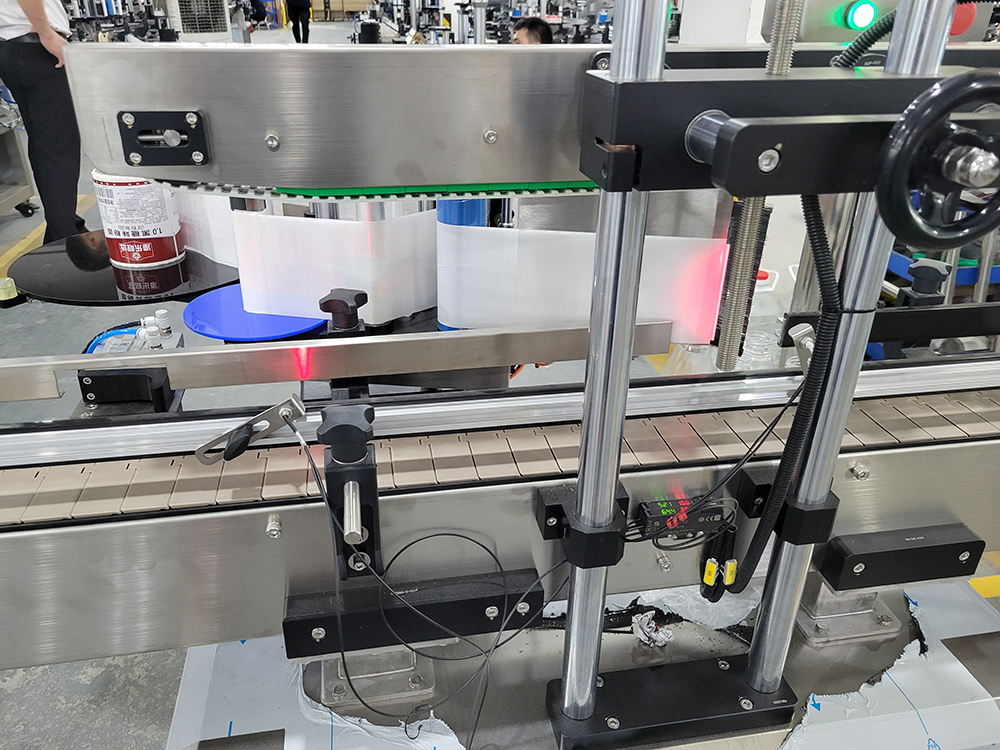
Label placement accuracy is the distance between where a label lands and where the artwork says it should land, measured on both axes. JNDTECH publishes plus or minus 1 mm for its standard self-adhesive builds. That figure decides whether a label clears the shoulder radius and whether a date code stays in its window.
Label Placement Accuracy: Two Numbers Behind One Figure
Accuracy is the average offset across a run. Repeatability is the spread around it. A machine can average 0.2 mm and still throw one bottle in fifty at 2 mm.
The published 1 mm covers the head placing a label on a bottle presented correctly to it. It does not cover the die-cut tolerance of the label or the moulding tolerance of the bottle.
Both sit upstream. When labels run low on one side only, the head is holding its number and the bottle is not. Check twenty bottles from the same mould cavity before touching the head.
Where the Millimetres Come From
Bottle registration comes first. A spacing screw and a star wheel set the gap, and a bottle arriving two millimetres off centre is labeled two millimetres off centre.
Web tension and the peel plate come next. The label must leave its backing at the same point every cycle, and slack in the unwind or a worn peel edge moves it. On the self-adhesive labeling machine range, label length runs from 20 to 400 mm, and a press belt set too tight slides the label before the adhesive grabs.
Bottle moulding comes last and buyers control it least. Diameter across the standard builds spans 30 to 150 mm, and no head holds 1 mm on a bottle whose diameter moves more.
What Each Method Can Hold
Placement risk differs by method. Self-adhesive is tightest because the label arrives pre-cut and pre-glued. Hot melt OPP and cold glue cut and glue inside the machine, so the cut edge and the glue film each add variation. A shrink sleeve labeling machine positions a film tube, then shrinks it.
| Method | Bottle diameter | Label size | Placement set by |
|---|---|---|---|
| Self-adhesive | 30 to 150 mm | 10 x 20 to 180 x 400 mm | Servo head, 1 mm published |
| Hot melt OPP | 50 to 95 mm, round | Height 10 to 150 mm | Cut length and glue |
| Cold glue | 40 to 110 mm | 10 x 120 to 120 x 200 mm | Cut length and glue |
| Shrink sleeve | 20 to 100 mm | Full body tube | Film feed and tunnel |
Read the diameter column first. A 100 mm jar is outside the hot melt and cold glue ranges, and a 20 mm vial is outside all three glue methods. Cost and changeover are compared in how to choose a bottle labeling machine.
How to Measure Label Placement Accuracy Without a Vision System
Take thirty consecutive bottles at the start of a shift, thirty at the middle and thirty at the end. Measure from the bottle base to the top label edge with a caliper.
Then plot the ninety readings. A tight cluster sitting two millimetres low is a setup error. A wide cluster centred on zero is a machine or bottle problem.
Why It Drifts at Speed and After a Changeover
Every increase in line speed shortens the window in which the label is transferred and pressed. At the top of a model's range, a belt that held 1 mm at half speed can lose it.
Changeover is the other drift point. Going from a 30 mm bottle to a 150 mm bottle means new guides, a new screw and a new recipe, and the first twenty bottles are the ones to check.
Putting the Number in the Purchase Order
A tolerance clause is worth more than a brochure figure. Write four things into it: the axis, the datum, the sample size, and the bottle and label the machine is judged against.
For factory acceptance, send your own bottles and label roll, and ask for ninety bottles across the speed range. A supplier's sample proves little about your bottles.
When One Millimetre Is the Wrong Target
Not every label needs the tightest number. On a wrap-around label covering most of the bottle, a small shift is invisible and the risk is the overlap at the seam. On a pharmaceutical vial the label edge must clear a fill line.
Match the clause to the consequence. If a shifted label only looks untidy, buy on speed. If it hides a date code, buy on accuracy.
Frequently Asked Questions
Is plus or minus 1 mm an accuracy figure or a repeatability figure?
Suppliers publish one figure for both. Ask which was measured, because a head repeating within 0.5 mm can still sit 3 mm off if the datum is wrong.
Why are labels sitting lower on one side of the bottle?
Usually the bottle, not the machine. A moulded bottle whose diameter varies, or whose seam sits proud, presents a different surface to the press belt.
Does a longer label change the tolerance?
Yes. The peel plate releases a longer label for longer, so a tension error has more time to show. The 400 mm label sets the practical tolerance.
Can an existing labeling machine be brought to plus or minus 1 mm?
Sometimes. Servo drive, a sharp peel edge and a sensor reading each bottle's leading edge are the three upgrades that matter.