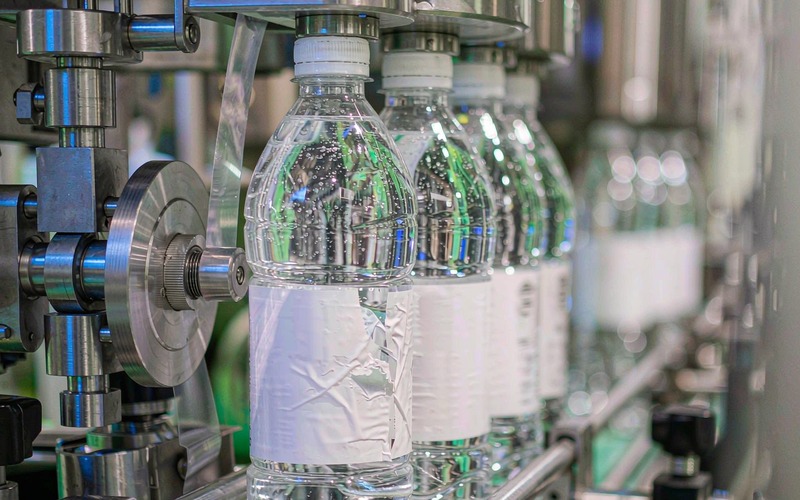
Labeling defects fall into three shapes: a wrinkle, a bubble and a lifted edge. Each begins at a different stage, so the shape is the fastest diagnostic available. Sort the defect before adjusting a setting, because a random change adds a second fault.
Labeling Defects: Match the Symptom to the Stage
None of the three yields to the same adjustment. The table below maps each visible shape to the stage that produces it.
| Defect | Stage it starts at | First check |
|---|---|---|
| Wrinkle across the label | Label feed against bottle speed | Line speed against label length |
| Wrinkle at the seam only | Overlap and press pressure | Overlap width on the round bottle |
| Bubble under the film | Air trapped at application | Press belt or brush contact |
| Lifted leading edge | Adhesive never activated | Bottle surface and press dwell |
| Lifted trailing edge | Glue line at the end of the wrap | Glue nozzle timing |
| Same bottle, same spot | The bottle, not the machine | Twenty bottles from one mould |
Wrinkles Point at Feed Speed, Not at Glue
On a hot melt line running 150 to 350 bottles per minute, a wrinkle usually means the label is fed faster or slower than the bottle passes. The label is stretched between the cut and the press, and the adhesive locks that stretch in place.
The hot melt labeling machine range covers bottle diameters of 45 to 95 mm and label heights of 10 to 150 mm. A 150 mm label carries more material to buckle than a 40 mm one, so a clean setting on a small label wrinkles on a tall wrap.
Change one variable at a time. Run twenty bottles at the current speed, then twenty slowed by a tenth. If the wrinkle clears, the feed is ahead of the bottle and the recipe label length needs correcting.
Bubbles Are Air the Press Belt Never Removed
A bubble is air that sat under the label when it was pressed down and stayed there. On a self-adhesive line the press belt does that work, so a worn or loose belt leaves air behind.
On the self-adhesive labeling machine, the largest build takes a label of 180 by 400 mm onto a 30 to 150 mm bottle. That length wraps most of the bottle, so a small loss of belt pressure shows as a bubble near the tail.
Hot melt systems bubble less often because the adhesive is applied molten and wets the surface. When they do, check the bottle: dust, condensation or release film stops contact.
Flagging Starts at the Label Edge
Flagging is an edge standing off the bottle, and the edge identifies the end that failed. A leading edge that lifts was never pressed onto a clean surface. A trailing edge lost its glue line at the wrap end.
On a cold glue labeling machine and on hot melt builds, adhesive goes on in strips. The strip at the trailing edge sits under the overlap, so a nozzle that fires late leaves the wrap end dry. The seam then opens on the pallet, not on the line.
Self-adhesive labels fail the same way for another reason. The adhesive needs pressure to wet out, and a belt that holds the middle fails at the edge.
Check the Bottle and the Roll Before the Settings
Two inputs cause more labeling defects than any setting: the bottle surface and the label roll. Neither belongs to the machine, so both get skipped.
Blow molded bottles carry a mould release agent, and an unrinsed bottle shows it as a patchy dull film. The label adheres to the film, not to the bottle. Label twenty bottles from one cavity by hand; if they lift, the fault is upstream.
Label rolls absorb moisture. A roll kept in a humid room curls at the edges, and a curled edge will not lie flat at any speed.
Placement is a separate question. A label that lies flat but lands off centre points at the head, which is what label placement accuracy measures.
A 30-Minute Sequence That Stops the Guesswork
Work in this order and the line answers the question: the first step that changes the defect identifies the stage.
Start with twenty bottles labeled by hand from the current roll. If they lift or bubble, fix the bottle or label. If they come out clean, the machine is the suspect.
Then run twenty bottles at half speed. Wrinkles that vanish belong to feed timing. Wrinkles that survive belong to the press or overlap.
Inspect the press belt and the glue nozzle before changing any number in the recipe. Both look like settings problems, and neither is. The comparison in how to choose a bottle labeling machine shows which method suits which bottle.
Frequently Asked Questions
Why do labels wrinkle only at high speed?
Because the gap between cutting the label and pressing it onto the bottle shortens. Feed and bottle must stay in step across it, and at the top of the range the margin is smallest.
Can a wrinkled label be flattened after it is applied?
Rarely. Once hot melt adhesive sets, the stretch is locked into the film. Pressing it again usually moves the wrinkle rather than removing it.
Why do labels bubble in the middle but stick at the edges?
The press belt contacts the edges first and the centre last. Air pushed toward the middle has nowhere to go, so a loose belt traps it where contact is shortest.
Why do labels lift a few days after production instead of on the line?
The adhesive never fully wet out, so it held by surface tension rather than bond. Condensation and dust both produce that delay.