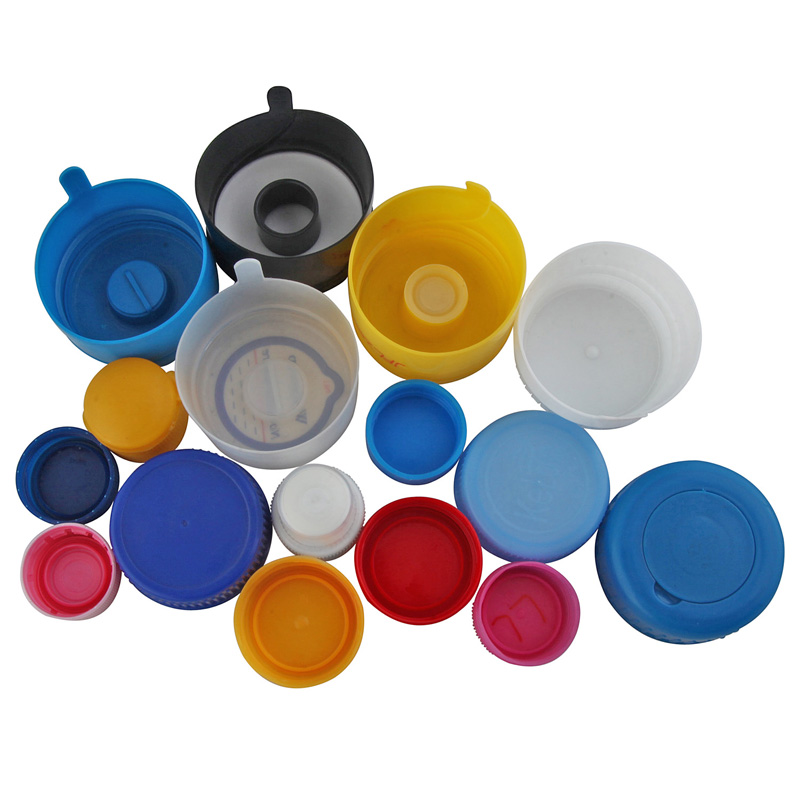
5 gallon bottle cap sealing is the fit between a 58 x 40 mm cap and the neck ring it locks onto, pressed home by a capping head at 0.5 to 0.6 MPa. JNDTECH runs one capping head at 120 BPH and two at 450 BPH. Most barrels that leak at a customer went out with a cap pressed slightly off square, not with a bad cap.
What 5 Gallon Bottle Cap Sealing Actually Holds
Three surfaces work together. The top disc rests on the neck land and carries the stack load. The inner wall grips the neck finish and holds the pressure. The tail, 18 by 7.5 mm on the standard cap, folds under the neck ring and stays there, so an opened barrel is visible without being opened.
A cap pressed off square leaves the tail standing proud on one side. A cap pressed too lightly keeps a flat top disc and lets the wall open later. The tail is the part a buyer judges in a second, and the last surface to seat.
Why a Barrel Leaks on the Truck and Not in the Plant
A barrel that passed a wet check still travels. Four high on a truck, the cap sits under everything above it, and the trailer warms and cools all day. A seal that held at the filling head can weep before the barrel reaches a cooler.
| What you see | Likely cause | First check |
|---|---|---|
| Cap tail lifted on one side | Head not square, or tray worn | One barrel from each head |
| Damp ring after inversion | Cap pressed below 0.5 MPa | Air gauge at the head mid cycle |
| Leak only in stacked barrels | Distorted cap wall | Tray condition and head alignment |
| Leak at the thread, cap looks sound | Neck out of tolerance | Measure ten bottle necks |
The cap keeps the angle it was pressed at. Off centre, the wall is thinner on one side, and stack load relaxes it until the seal opens. A PET 5 gallon bottle blow molding machine with a cold mould or a worn neck insert leaves the thread diameter out of tolerance, and no capping head recovers it.
The 0.5 MPa Floor Under the Capping Head
The capping head needs at least 0.5 MPa of air to press a cap square. JNDTECH sets the working range at 0.5 to 0.6 MPa and stops the capping machine when supply falls to 0.5 MPa or below, because a cap pressed under that pressure distorts instead of seating.
That cut-off is a setting, not an obstacle. Overriding it trades one stoppage for barrels that leak in the field, where the complaint arrives with no batch number on it. Fit a gauge at the head and read it during a cycle.
One Capping Head at 120 BPH, Two at 450 BPH
Head count is fixed at order and sets how long each cap is under pressure. The 120 BPH build runs one head, the 450 BPH build runs two, so the faster machine splits output rather than driving one head harder. Two heads also means two settings to hold.
Output sets the sample size. At 120 BPH an eight hour shift fills 960 barrels, few enough to open one from every pallet. At 450 BPH the same shift fills 3,600, so sampling follows the pallet pattern instead. Sizing is covered in how to choose a 5 gallon filling machine.
Cap Trays, Cap Washing and How Caps Are Stored
The cap tray holds caps so each one seats square, and it is the part most often skipped in cleaning. Dust in the tray delivers caps at a slight angle, and the head presses that angle into the cap.
Caps kept in open trays beside the machine collect dust on the top layer through a shift. Cap washing, an option on the JND100 series, rinses caps before they are pressed on. Where caps arrive sealed in a covered hopper the option earns less, and the 5 gallon water filling line can be specified either way.
Testing the Seal Before the Barrels Leave
Two checks cover most failures and neither needs a laboratory. Fill a barrel, cap it, lay it on its side with the cap down and leave it overnight. A weep shows as a damp ring. Take the barrel from a capping head, not from the end of the line.
Then run a thumb around the tail. It should sit flat under the neck ring all the way round, with no lift at the seam. Log both results by head and shift. Worn head seals belong in the 5 gallon water bottling line maintenance checklist.
Frequently Asked Questions
Should a 5 gallon cap be tightened to a torque?
No. The cap is pressed, not screwed, so 5 gallon bottle cap sealing has no torque figure to set. Check instead whether the tail sits under the neck ring all the way round.
Why do barrels leak only when they are stacked?
Stack load pushes the top disc down and opens the wall on the low side of an off square cap. Check the tray and head alignment before changing the cap supplier.
Can the machine run a different cap size?
The standard build takes a 58 x 40 mm cap on an 18.9L barrel. A different cap needs a different tray and capping head, so confirm dimensions before the order.
Does cap washing improve sealing?
It removes dust that stops the tail seating, which helps on caps stored in open trays. It will not fix a head that is out of adjustment.