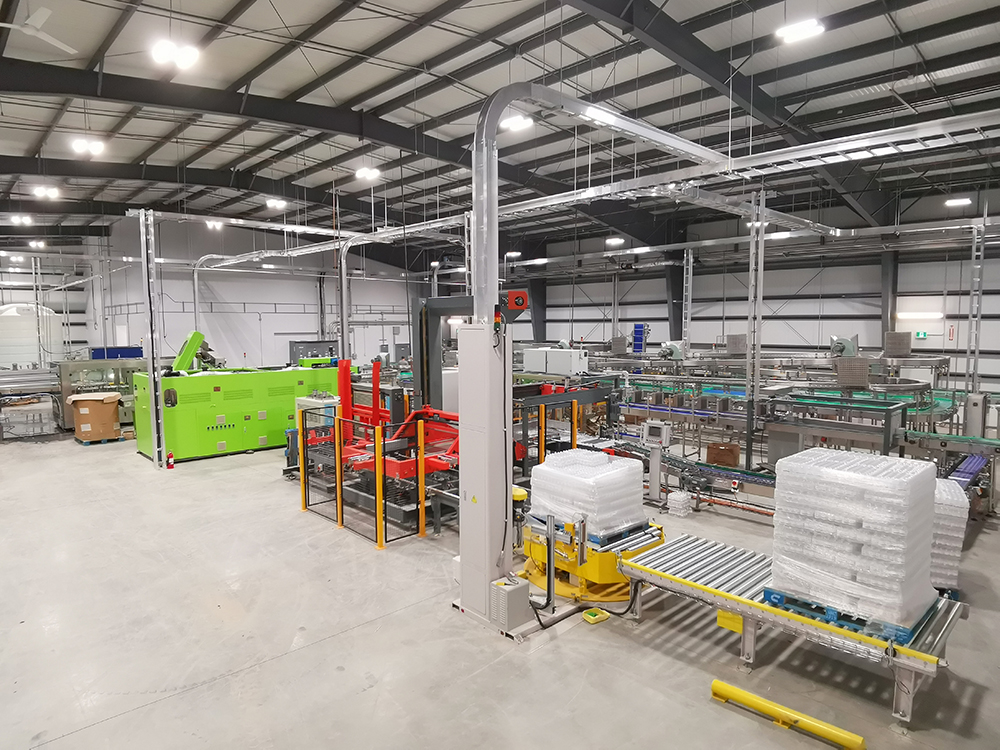
What Is a Complete Water Filling Line?
A complete water filling line takes two inputs, raw water and PET preforms, and turns them into sealed, labeled bottles of drinking water. Most lines share five main stages: water treatment, bottle making, rinsing-filling-capping, labeling and coding, and packing and palletizing. Knowing what each stage does helps you plan a plant, compare supplier quotations, and avoid mistakes that only show up after the line is installed.
Stage 1: Water Treatment
Product quality starts here. Raw water from a well, spring or municipal supply has to be purified before it can be bottled. A typical treatment system has four parts:
- Multi-media filtration. Removes sand, rust and suspended solids.
- Activated carbon filter. Removes chlorine, smell and organic matter.
- Reverse osmosis (RO) or ultrafiltration (UF). Removes dissolved salts, bacteria and viruses.
- UV sterilizer and ozone generator. Final disinfection, plus bottle hygiene.
Capacity is matched to your filling speed, usually 1 to 20 tons per hour for bottling plants.
Stage 2: Bottle Making Machine
Most plants make their own PET bottles with a blow molding machine, which heats preforms and blows them into molds. Producing bottles in-house lowers bottle cost, gives you control over weight and quality, and removes the need to store bulky empty bottles. For still water, a blowing-filling-capping combiblock can combine this stage with filling to save floor space.
Stage 3: Rinsing, Filling and Capping (3-in-1 Monoblock)
For most still water, these three steps happen inside one machine, the 3-in-1 filling monoblock. Bottles enter the machine and are rinsed by inverted grippers spraying purified water or sterile air. They move straight into gravity or negative-pressure filling, which gives accurate, no-drip levels with low dissolved-oxygen pickup. Then magnetic capping heads apply screw caps with adjustable torque, and a sensor rejects missing or skewed caps, all before the bottle leaves the machine.
Because rinsing, filling and capping share one frame, there is one transfer point, less contamination risk and a smaller footprint. The monoblock is rated as a single unit, typically from 2,000 to 15,000 BPH.
Stage 4: Labeling and Coding
Filled bottles go through a labeling machine (self-adhesive, OPP hot-melt or shrink sleeve) and a date coder that prints batch and expiry information. This is the step that makes the product retail-ready and traceable.
Stage 5: Packing and Palletizing
Finished bottles are bundled into retail packs by a shrink wrapping machine or case packer, then stacked onto pallets by a palletizer and wrapped in stretch film. Good packing protects the product in transport, and clean palletizing keeps warehouse and container loading efficient.
Equipment Checklist: What Your Line Needs
| Stage | Equipment | Typical Capacity |
|---|---|---|
| Water treatment | Multi-media, carbon, RO/UF, UV, ozone | 1 - 20 TPH |
| Bottle making | PET blow molding machine or combiblock | 2,000 - 15,000 BPH |
| Rinsing-filling-capping | 3-in-1 monoblock | 2,000 - 15,000 BPH |
| Labeling & coding | Labeling machine + date coder | Up to 30,000 BPH |
| Packing | Shrink wrapper / case packer | 15 - 30 packs/min |
| Palletizing | Palletizer + stretch wrapper | Up to 8 layers/min |
Match Capacities or You Get a Bottleneck
The most common mistake in line design is mismatched capacities. If your filler runs 12,000 BPH but your blow molder only makes 8,000 bottles, you lose 4,000 bottles every hour. Match every stage, or deliberately oversize one stage for headroom, and design the line as a whole rather than as separate machines.
What JNDTECH Provides: From Site Selection to Training
JNDTECH does more than sell machines. Before you order, our engineers help with site selection and factory layout design, so the line fits your building and leaves room for expansion. We develop the bottle design and molds for your pack size, deliver the complete line, and handle on-site installation, commissioning and operator training. After handover, you get a 1-year warranty and 24-hour after-sales support.
Frequently Asked Questions
How much does a complete water filling line cost?
It depends on capacity and automation. A small 2,000-3,000 BPH workshop line costs far less than a 15,000 BPH plant with full automation. Send your target output and bottle size for a tailored quotation.
Do you help with factory layout and mold design?
Yes. Site selection advice, factory layout design, and bottle and mold development are all part of the project, so you get a line that fits your building and your pack size.
Can I buy only part of the line now and expand later?
Yes. Many customers start with the 3-in-1 filling machine and add blowing, labeling and packing later. Design the layout with expansion in mind from day one.
Do you install the complete line?
Yes. JNDTECH provides on-site installation, commissioning and operator training, plus a 1-year warranty and 24-hour after-sales support.
Plan Your Complete Line with JNDTECH
JNDTECH designs and builds complete water filling lines from 2,000 to 15,000 BPH, with layout design, bottle and mold development, installation and training all included. Contact JNDTECH for a free layout drawing and quotation.